
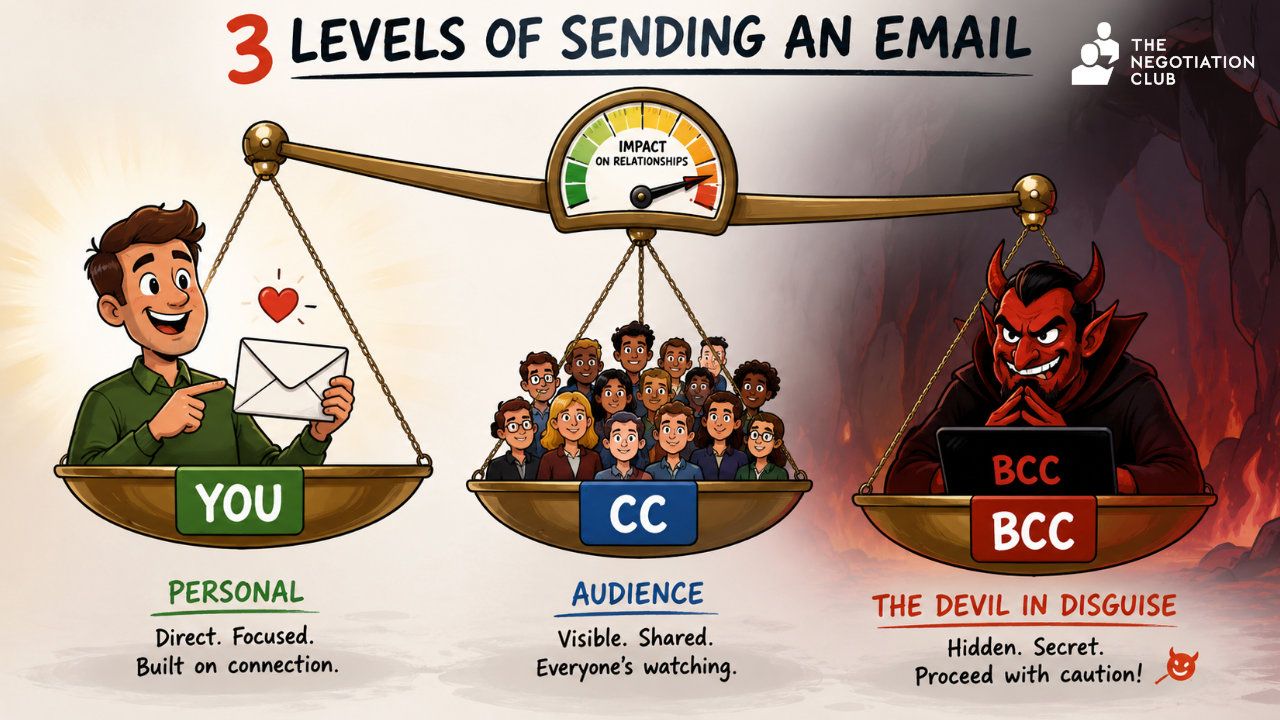
The Hidden Negotiation Behind Every CC and BCC
Most people think CC and BCC are simply administrative features within an email system.
They are not.
They are communication tools that can quietly influence relationships, trust, credibility, rapport and negotiations.
A single click can make someone feel included, excluded, trusted, embarrassed, supported or undermined.
It can make a message feel personal and important, or generic and disposable.
It can also create pressure, uncertainty or suspicion without the sender ever writing a single threatening word.
Yet very few people stop to consider what message they are really sending when they copy another person into an email.
Good negotiators understand that every communication changes the relationship.
That includes the decision about who receives the email, who is copied into it, who is hidden from view and whether the person reading it feels that the message was genuinely written for them.
CC Is Not Just an Administrative Function
CC originally meant “carbon copy”, but in modern business communication it has become much more than a way of distributing information.
It can be used to:
- provide visibility,
- establish responsibility,
- introduce colleagues,
- demonstrate progress or
- ensure that relevant stakeholders remain informed.
However, it can also be used to:
- apply pressure,
- create an audience,
- escalate a disagreement or
- protect the sender.
The technology may be neutral, but the decision to use it is not.
Every person added to an email changes the communication dynamic.
The email may contain exactly the same words...
but the presence of another recipient ...
can completely change how those words are interpreted.
The Micro-Moment Before You Press Send
At The Negotiation Club, we explore the importance of recognising and practising negotiation micro-moments.
A micro-moment is a seemingly small decision, behaviour or action that influences the direction of a relationship.
On its own, it may appear insignificant. However, these moments accumulate over time and shape trust, credibility, openness and influence.
Adding someone to the CC field is one of those micro-moments....
- So is deciding to place twenty people into the same message.
- So is deciding whether to use BCC.
- So is deciding whether to take an extra minute to make the email feel personal.
Each decision may take only a second, but it can alter the recipient’s perception of the entire message.
They may immediately begin to wonder:
- Why has my manager suddenly been copied?
- Is this becoming a formal matter?
- Am I being challenged or criticised?
- Is someone building an evidence trail?
- Does the sender not trust me?
- Am I now expected to defend my position publicly?
- Was this message actually written for me?
- Who else has received this without my knowledge?
None of these interpretations may have been the sender’s intention.
However, negotiation is not driven by intention alone. It is also driven by perception.
The best negotiators develop the habit of pausing before pressing Send.
That pause is a micro-moment in itself.
Instead of simply asking:
“Who else should I copy into this email?”
they ask:
“What message will each recipient believe this decision is sending?”
That small change in thinking can lead to a very different decision.
Why CC Changes the Conversation
The moment another person is copied into an email, the conversation changes.
It is no longer a discussion between two people .... There is now an audience!
People frequently behave differently when they know they are being observed.
Someone who may have been willing to acknowledge a mistake in a private conversation may become defensive when their manager, colleague or senior stakeholder is copied into the exchange.
Instead of concentrating on solving the problem, they may begin protecting their reputation.
The conversation becomes less collaborative and more performative.
People start writing for the audience rather than communicating with the person they need to influence.
This is one reason negotiations can deteriorate when senior people are brought into a discussion too early.
The additional visibility may appear helpful, but it can reduce honesty, flexibility and the willingness to explore possible compromises.
Your Intention Is Not Necessarily Their Interpretation
A sender may copy someone into an email with the innocent intention of keeping them informed.
However, the recipient may interpret the action very differently.
The sender may be thinking:
“I want to keep everyone updated.”
The recipient may read it as:
- “I do not trust you to provide an update.”
- “I am escalating this matter.”
- “I am creating evidence.”
- “I want your manager to see that you have not responded.”
- “I am applying pressure by creating an audience.”
The meaning of a CC is rarely contained in the email itself.
It is interpreted through the existing relationship, the circumstances surrounding the email and the perceived motives of the sender.
Good communicators do not only consider what they intend to communicate.
They consider how their behaviour is likely to be interpreted by the other person.
When Using CC Is Helpful
There are many occasions when copying another person into an email is entirely appropriate.
CC can help to:
- Keep relevant project stakeholders informed.
- Ensure that everyone has access to the latest information.
- Introduce colleagues who will need to become involved.
- Confirm agreed actions and responsibilities following a meeting.
- Provide visibility where several people have related responsibilities.
- Allow someone to remain informed without requiring them to respond.
- Create a shared and transparent record of an agreed position.
The key distinction is that the CC is being used to share relevant information, rather than to manipulate behaviour or create unnecessary pressure.
Where the reason for copying someone is clear and proportionate, the action can support trust and coordination.
Where the reason is unclear, the recipient is likely to fill the gap with their own interpretation.
When CC Damages Relationships
Problems arise when CC becomes a weapon.
This can happen when someone:
- Copies a manager into an email to force a faster response.
- Includes senior leadership to highlight another person’s mistake.
- Creates an audience to make disagreement more difficult.
- Escalates a matter before attempting to resolve it privately.
- Copies others primarily to protect themselves.
- Uses CC to imply authority that they do not personally hold.
These approaches may occasionally achieve a short-term result.
However, they often weaken the relationship.
The recipient may comply, but they are less likely to collaborate openly in future.
That is an important distinction in negotiation.
Compliance is not the same as commitment. You may succeed in forcing someone to act, but lose their willingness to help you later.
Why Private Conversations Often Work Better
Experienced negotiators understand that people are often more willing to solve problems privately than publicly.
Without an audience, people can:
- Admit mistakes.
- Ask questions.
- Explore options.
- Change their position.
- Compromise without losing face.
- Explain pressures they may not want to reveal publicly.
This is why many of the most important negotiation conversations happen outside the formal meeting.
The same principle applies to email.
Before copying in a manager, colleague or senior stakeholder, consider whether a direct conversation could resolve the issue first.
Sometimes a short phone call, Teams message or private email will achieve more than an escalation involving ten people.
The Problem With Sending One Message to Everyone
Some people use CC as a convenient way to distribute the same message to a large group.
... It saves time?!
However, it can also seriously dilute the impact of the communication.
When a recipient sees that the same email has been sent to dozens of other people, the message immediately feels less personal.
It can create the impression that:
- The message was not written specifically for them.
- Their response is probably not particularly important.
- Someone else will deal with it.
- The sender is broadcasting rather than communicating.
- The relationship is transactional rather than personal.
This can be especially damaging when the purpose of the email is to build rapport, ask for support, influence a decision or begin a negotiation.
People tend to respond better when they believe they are the person being spoken to.
They are more likely to engage when the message recognises their individual role, contribution or perspective.
People generally prefer doing business with people, not distribution lists.
Personalisation Does Not Have to Take Hours
The argument for mass CC emails is usually efficiency.
It is quicker to write one message and send it to everyone.
However, modern technology makes it relatively simple to create individual emails using a contact list or mail merge.
Each person can receive a direct message addressed to them by name.
The email can also include a short personal comment drawn from the merge data.
For example:
“Mary, I thought your experience with the Exeter project would make your perspective particularly useful.”
Or:
“John, I know you raised this issue in our previous discussion, so I wanted to contact you directly.”
These small additions can significantly increase the personal impact of the message.
The central content may be largely the same, but the recipient feels recognised.
That recognition strengthens the relationship and increases the likelihood of a meaningful response.
This is another negotiation micro-moment.
The sender is deciding whether to save a few minutes or invest those minutes in making the recipient feel individually valued.
The Risk of Diffused Responsibility
There is another problem with group emails.... The more people who receive the message, the easier it becomes for each person to assume that someone else will respond.
This is particularly common where several recipients hold similar responsibilities.
- A direct email ... creates ownership.
- A group email ... can create ambiguity.
Compare:
“Can someone provide the figures by Friday?”
with:
“Sarah, would you be able to provide the figures by Friday?”
The second message is clearer, more personal and more likely to result in action.
If others need visibility, they can still be copied in, but responsibility should remain explicit.
A CC or BCC Is the Beginning, Not the End
It is easy for the sender to think that their job is finished once the email has been sent.
They have written the message, selected the recipients and pressed Send.
However, for everyone receiving the email, the communication has only just begun.
Each additional recipient must interpret why they have been included and decide what, if anything, they are expected to do.
They may ask themselves:
- Am I expected to respond?
- Am I being asked to intervene?
- Is this simply for information?
- Should I monitor what happens next?
- Does the original recipient know that I have seen this?
- Am I now accountable for taking some action?
- Is this information confidential?
If the sender has not considered these questions, they have transferred uncertainty to everyone else.
This is similar to a negotiator making a proposal and believing that their work in that moment is complete.
In reality, the proposal is only the beginning.
The other party must interpret it, compare it with their expectations, assess the motives behind it and decide how to respond.
The same principle applies to email.
Every CC or BCC can trigger a micro-moment cascade.
The sender’s decision creates a series of new decisions, assumptions and reactions for every person included.
A skilled communicator therefore considers not only whether someone should receive the email, but what will happen after they receive it.
Understanding BCC
BCC means “blind carbon copy”.
It allows someone to receive an email without the other recipients knowing that they have received it.
There are legitimate uses for BCC.
These include:
- Protecting recipient privacy in a large mailing.
- Sending newsletters or general announcements.
- Avoiding the disclosure of personal email addresses.
- Distributing information where recipients do not need to see one another’s details.
Outside these limited situations, BCC creates a significant communication problem.
The hidden recipient will normally receive the original email without any explanation of why it has been sent to them.
There may be no instruction about whether they should respond, intervene, retain the message, monitor the issue or simply read it.
They have been given visibility, but not necessarily clarity.
This means the sender may have solved their own need to share the information while creating uncertainty for the person receiving it.
The hidden recipient may also be placed in an awkward position.
If they act on the email, they may reveal that they received it secretly.
If they do nothing, they may worry that the sender expected them to intervene.
If they mention the content later, they may damage trust between the original parties.
BCC does not simply hide a recipient.... It can place that recipient inside a conversation without giving them a clear or honest role.
Should Managers Receive Hidden Copies of Their Team’s Emails?
Some managers may encourage or expect team members to BCC them into routine communications because they want complete visibility.
This may feel like an efficient way to stay informed.
However, it raises important questions about trust, accountability and management culture.
Should a manager need to receive hidden copies of all their team’s external or internal emails in order to manage effectively?
In most cases, probably not.
A routine expectation that managers are secretly copied into communications may create:
- A culture of surveillance rather than trust.
- Confusion about who owns the relationship.
- Reluctance among team members to communicate openly.
- Defensive writing designed for the manager rather than the recipient.
- Uncertainty about whether anyone is ever communicating privately.
- An excessive volume of information without clear priorities.
Managers do need appropriate visibility.
However, that visibility should usually be created openly and deliberately.
It might be achieved through:
- Regular project updates.
- Agreed reporting arrangements.
- Shared systems and records.
- Clearly defined escalation points.
- Open CC where managerial visibility is genuinely required.
- Scheduled one-to-one discussions.
A manager who requires hidden access to every conversation may receive more information, but that does not necessarily mean they have better control.
They may instead create a team that becomes cautious, dependent and less willing to exercise judgement.
'Visibility' is not the same as effective management.
BCC as a “Cover My Arse” Signal
In some situations, BCC can become a powerful “cover my arse” signal.
The sender may secretly copy a manager, colleague, adviser or senior stakeholder to create evidence, demonstrate that they have acted or protect themselves if the situation later goes wrong.
The sender may believe that this is prudent.
However, it is worth asking why the protection needs to be hidden.
If another person genuinely needs visibility for governance, approval, accountability or support, it is usually better to make their involvement explicit.
A hidden copy may indicate that the sender wants the benefits of involving another person without accepting the relational consequences of doing so openly.
If the hidden recipient later replies, refers to the message or accidentally reveals their involvement, the damage to trust can be immediate.
The original recipient may begin to question:
- Why was this person secretly included?
- Was the email written for me or for the hidden audience?
- What else has been shared without my knowledge?
- Was the sender trying to protect themselves at my expense?
- Can I trust future communications to remain private?
The hidden recipient may also be placed in a difficult position because they have been given information without a defined role.
They may not know whether they are expected to intervene, observe or simply retain the message as evidence.
Once these questions arise, both relationships can be affected: the relationship between the sender and the original recipient, and the relationship between the sender and the person secretly copied.
A hidden audience can make every future conversation feel less safe.
If You Need a Record, Be Honest About It
There may be situations where a formal record is genuinely required.
There may also be governance, compliance or legal reasons for keeping another person informed.
In those circumstances, transparency is usually the better approach.
Rather than using BCC, consider stating openly:
“I have copied Sarah into this email because she is responsible for the approval process.”
Or:
“I have included James so that he has visibility of the agreed actions.”
This removes ambiguity.
It allows the recipient to understand why the other person is present and reduces the likelihood that the CC will be interpreted as a threat or escalation.
Openness does not remove every disagreement, but it usually creates a more credible process.
Forwarding Can Be a Clearer Alternative
Where another person genuinely needs to see an email but does not need to be part of the original conversation, forwarding the message afterwards can be a better approach.
The original email can first be sent directly to the intended recipient.
It can then be forwarded separately to the person who requires visibility.
This gives the sender an opportunity to explain:
- Why the email is being shared.
- Whether any action is required.
- Whether the message is being provided only for information.
- Whether the original recipient knows it has been forwarded.
A simple subject line such as:
“FOR INFO – Supplier discussion”
can immediately signal that no action is expected.
Where the reason is not obvious, one additional sentence can provide even greater clarity:
“For information only. I am forwarding this because it may affect the timetable you are managing, but no action is required at this stage.”
This approach is more deliberate than BCC.
It separates the original communication from the secondary information-sharing decision.
It also gives the secondary recipient a clear role.
The sender is no longer merely providing visibility.
They are explaining the purpose of that visibility.
The Hidden Risk of Reply All
Reply All deserves separate consideration.
People often use it automatically without asking whether every recipient genuinely needs the response.
Large email chains quickly become frustrating, but the deeper issue is that every additional recipient enlarges the audience.
The wider the audience, the less likely people are to speak openly.
A reply that might have been constructive in private can become defensive when sent to fifteen people.
Sometimes the best communication decision is not to add more people.
It is to remove them.
Before using Reply All, ask:
- Does everyone need this response?
- Am I replying to inform, or to demonstrate something publicly?
- Would a direct response be more effective?
- Am I unintentionally escalating the matter?
Time-Saving Has Consequences
CC and BCC are often used because they are quick.
- One email can reach twenty people.
- One click can provide a manager with visibility.
- One hidden copy can create a record.
... However, the time saved by the sender may create additional work elsewhere!
- Recipients may become confused about responsibility.
- People may respond defensively.
- Trust may need to be repaired.
- Senior stakeholders may become involved unnecessarily.
A message that could have been resolved privately may turn into a lengthy email chain.
Efficiency should not be measured only by how quickly the email was sent.
It should also be measured by the quality of the response and the effect on the relationship.
A shortcut in communication can become a long route to rebuilding trust.
A Practical Test Before Pressing Send
Before adding anyone to CC or BCC, pause and ask:
- Does this person genuinely need the information?
- Why am I including them?
- Will their inclusion help solve the problem or simply create pressure?
- Would I include them if everyone were sitting in the same room?
- Could I resolve the issue privately first?
- Will the original recipient understand why this person has been copied?
- Will the copied person understand why they have received it?
- Have I made it clear whether they need to act?
- Am I expecting them to intervene, observe or simply remain informed?
- Am I using BCC because I am unwilling to be open about who is involved?
- Would forwarding the email separately provide greater clarity?
- Would individual emails create a stronger response?
- Can I add one personal sentence that shows why I am contacting this person?
- Am I saving time at the expense of trust, clarity or impact?
These questions take only a few seconds.
However, they help the sender consider the complete chain of consequences rather than only the convenience of pressing Send.
Practise This With Your Team
This is an excellent subject for negotiation practice because almost everyone uses email, but very few people consciously practise how they use it.
Create a series of realistic workplace scenarios.
For each scenario, ask participants to decide:
- Who should receive the email directly?
- Who, if anyone, should be copied?
- Should anyone be BCC’d?
- Would individual messages be more effective?
- What personal sentence could be added?
- What message does the recipient infer from the distribution list?
- Could a phone call or Teams message achieve a better outcome?
Then ask one participant to take the role of the sender and another to take the role of the recipient.
The recipient should explain how the email makes them feel and what assumptions they make about the sender’s intentions.
You can extend the exercise by giving a third participant the role of the person copied into the message.
Ask them:
- Do you know why you have received this?
- Do you believe you are expected to act?
- Would you feel comfortable referring to the email later?
- How might your presence affect the original recipient?
This turns an abstract discussion about email etiquette into a practical exercise in perception, trust and influence.
The learning is not really about email.
It is about recognising the impact of small communication choices.
Every Micro-Moment Counts
Every negotiation is built from hundreds of micro-moments.
- The decision to add someone to a CC list is one of those moments.
- The decision to send one generic message to fifty people is another.
- The decision to secretly copy someone using BCC is another.
Each action may take only a second, but it can influence trust, openness and cooperation long after the email has been sent.
The act of sending the email is not the end of the micro-moment.
It is the beginning of a cascade.
Every recipient must interpret why they have been included, what is expected of them and what the distribution list says about the sender’s intentions.
Great negotiators think beyond the action they take. They consider the sequence of reactions that action is likely to create.
Great negotiators do not simply write better emails.
They become aware of the micro-moments hidden inside them.
They understand that people respond more positively when they feel recognised, respected and spoken to directly.
They also recognise that hidden audiences, unnecessary escalation and generic distribution lists can undermine the very relationship they are trying to build.
Every CC tells a story...
Every BCC tells a story that someone was not supposed to know.
Sometimes the most important negotiation decision is not what you write.
It is who you choose to include, who you choose to exclude and whether the person receiving it feels that you were genuinely speaking to them.
Author


