
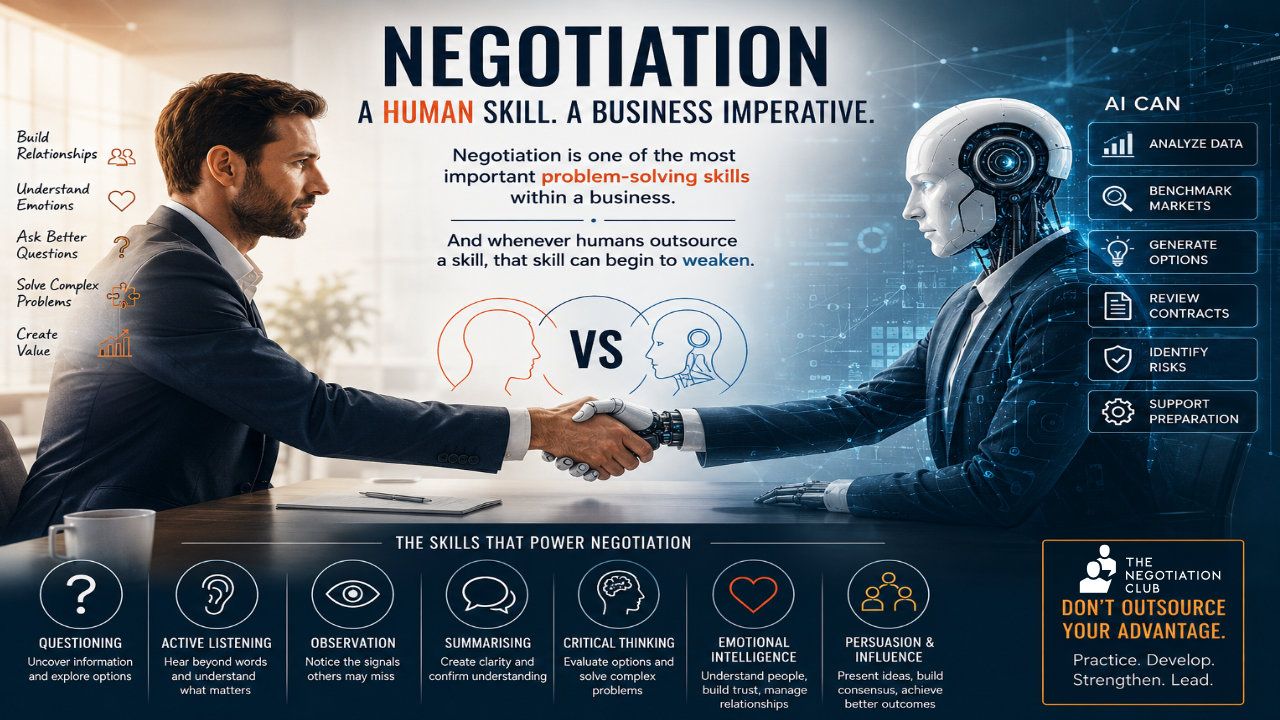
Has Procurement Started Outsourcing Negotiation to AI?
Artificial Intelligence is rapidly becoming part of the procurement toolkit.
Today it can analyse spend, compare supplier proposals, identify contractual risks, recommend negotiation strategies, generate negotiation scripts and even conduct parts of a negotiation conversation itself.
Many organisations view this as progress.
But the question may not be whether AI can negotiate.
The real question may be whether organisations fully understand what they are giving away when they allow AI to negotiate on their behalf.
Because negotiation is not simply a procurement activity.
Is The Procurement Function, the First Domino?
Procurement is often the natural starting point for AI negotiation.
The opportunities appear obvious:
- Supplier pricing
- Contract terms
- Payment terms
- Service levels
- Delivery schedules
- Volume commitments
- Performance management
- Tender evaluations
- Contract renewals
Many procurement professionals already use AI to draft emails, prepare supplier questions and analyse proposals.
The next step is easy to imagine.
---> An AI agent receives a supplier proposal.---> It analyses market conditions.---> It benchmarks prices.---> It generates counter-proposals.---> It exchanges messages with the supplier.---> It reaches an agreement.---> It documents the outcome.
---> The procurement professional simply approves the result.
🤔 Efficient? ...Potentially.
🫣 Dangerous? ... Possibly.
Because every negotiation that AI conducts is one less negotiation that a human being practises.
Never Forget That Skills Only Improve Through Use
Most organisations understand this concept in other disciplines.
If a company automated all financial analysis, would it still develop strong finance professionals?
If pilots never flew aircraft manually, would their abilities deteriorate?
If lawyers relied entirely on AI to construct legal arguments, would advocacy skills decline?
The same principle applies to negotiation.
Negotiation is not a theoretical discipline. It is a practical skill.
Like riding a bicycle, playing a musical instrument or learning a language, proficiency is built through repetition.
"You improve by negotiating. You do not improve when software negotiates for you."
Join a FREE Negotiation Taster Session
Join the APAC Negotiation Club (£44.00 pm)
Join the Student Negotiation Club (£9.99 pm)
There Are Hidden Skills Inside Negotiation
One of the biggest misconceptions about negotiation is that it is simply about reaching an agreement.
In reality, negotiation develops dozens of professional skills that are valuable far beyond procurement.
Questioning
Strong negotiators learn how to ask questions that uncover information.
They learn to use:
- Open questions
- Clarification questions
- Diagnostic questions
- Challenging questions
- Exploratory questions
These are exactly the same skills used by leaders, consultants, lawyers, project managers and sales professionals.
If AI begins conducting negotiations, when do people practise questioning?
Active Listening
Negotiation requires listening beyond words.
Effective negotiators learn to identify:
- Hesitation
- Emotion
- Confidence
- Uncertainty
- Contradictions
- Hidden concerns
AI may process language, but humans must still develop judgement through Active Listening.
Without practice, that judgement weakens.
Observation
At The Negotiation Club, observation is one of the core skills we practise.
Negotiators learn to observe:
- Body language
- Tone changes
- Pace changes
- Emotional reactions
- Agreement signals
- Rejection signals
These observations are critical in business generally. Not just procurement. Not just sales.
Every leadership conversation depends on observation.
Summarising
Many professionals underestimate the importance of summarising.
Strong negotiators constantly summarise:
- Understanding
- Agreements
- Concerns
- Priorities
- Progress
Summarising demonstrates listening, prevents misunderstandings and helps move discussions forward.
It is equally valuable in leadership meetings, project management and stakeholder engagement.
Critical Thinking
Negotiation is fundamentally a problem-solving exercise.
Every negotiation involves:
- Conflicting objectives
- Limited information
- Constraints
- Risks
- Opportunities
Negotiators must continuously evaluate options and adapt.
AI can provide suggestions. But if humans stop exercising critical thinking themselves, decision quality eventually suffers.
Emotional Intelligence
One of the most difficult skills to automate is emotional intelligence.
Negotiators constantly assess:
- Trust
- Frustration
- Confidence
- Anxiety
- Motivation
- Relationships
These human factors frequently determine whether an agreement succeeds or fails.
Negotiation is rarely purely rational.
The ability to understand emotions improves only through interaction with other people.
Persuasion and Influence
Negotiation develops the ability to:
- Present arguments
- Frame proposals
- Build consensus
- Influence decisions
- Gain support
These capabilities are essential for leadership roles.
If AI increasingly performs these activities, future leaders may have fewer opportunities to develop them.
The Bigger Risk: Negotiation Expands Beyond Procurement
The real concern is not limited to supplier negotiations.
The real concern is what happens next.
If AI can negotiate supplier contracts, why stop there?
Could it negotiate:
- Salaries?
- Bonuses?
- Flexible working requests?
- Promotions?
- Business cases?
- Budget allocations?
- Strategic partnerships?
- Joint ventures?
- Resource allocation?
At first glance, this may sound unlikely.
But procurement professionals know how quickly technology adoption can accelerate once commercial value is proven.
The same argument used for supplier negotiations could be applied elsewhere:
- It saves time.
- It removes bias.
- It improves consistency.
- It achieves better outcomes.
Eventually the question becomes:
Where do we still expect humans to negotiate?
The Organisational Capability Risk
Businesses often focus on immediate efficiency gains.
Few focus on capability erosion.
Imagine a procurement team where AI has conducted most negotiations for five years.
A crisis emerges.
A critical supplier relationship breaks down.
A complex dispute occurs.
The AI recommendation is inadequate.
The organisation suddenly needs experienced negotiators.
Will they still have them?
Or will they have managers who have spent years approving recommendations rather than developing expertise?
The danger is not simply that AI might fail. The danger is that humans may lose competence.
Negotiation Is a Human Problem-Solving Skill
At The Negotiation Club, we view negotiation differently from many traditional training providers.
Negotiation is not simply a commercial process.
It is a problem-solving skill.
Every day people solve problems through:
- Questions
- Listening
- Observation
- Summarising
- Persuasion
- Influence
- Relationship building
- Critical thinking
Negotiation provides a practical environment in which these skills are developed.
That is why practice matters.
Not because everyone needs to become a procurement professional.
Not because everyone needs to become a salesperson.
But because negotiation develops skills that are valuable across every function of a business.
The Future Should Not Be AI Versus Humans
The most successful organisations will probably not choose between humans and AI.
They will combine both.
AI can support negotiation by helping people:
- Analyse data
- Benchmark markets
- Generate options
- Review contracts
- Identify risks
- Prepare more effectively
Humans must still retain the ability to:
- Build relationships
- Exercise judgement
- Interpret emotions
- Create trust
- Navigate ambiguity
- Solve complex problems
The challenge for business leaders is ensuring that AI remains a tool rather than becoming a substitute for skill development.
Because once a capability disappears, rebuilding it can take years.
And unlike software licences, human negotiation capability cannot simply be switched back on.
My Personal Thoughts On This
The question may not be whether AI can negotiate better than some people.
The more important question is this:
"If we allow AI to negotiate on our behalf today, are we investing in organisational capability,
... or slowly outsourcing one of the most valuable human problem-solving skills a business possesses?"
That is a question every procurement leader, HR director, CEO and board member should be considering now, before convenience quietly becomes dependency.
Join a FREE Negotiation Taster Session
Join the APAC Negotiation Club (£44.00 pm)
Join the Student Negotiation Club (£9.99 pm)
Author


