
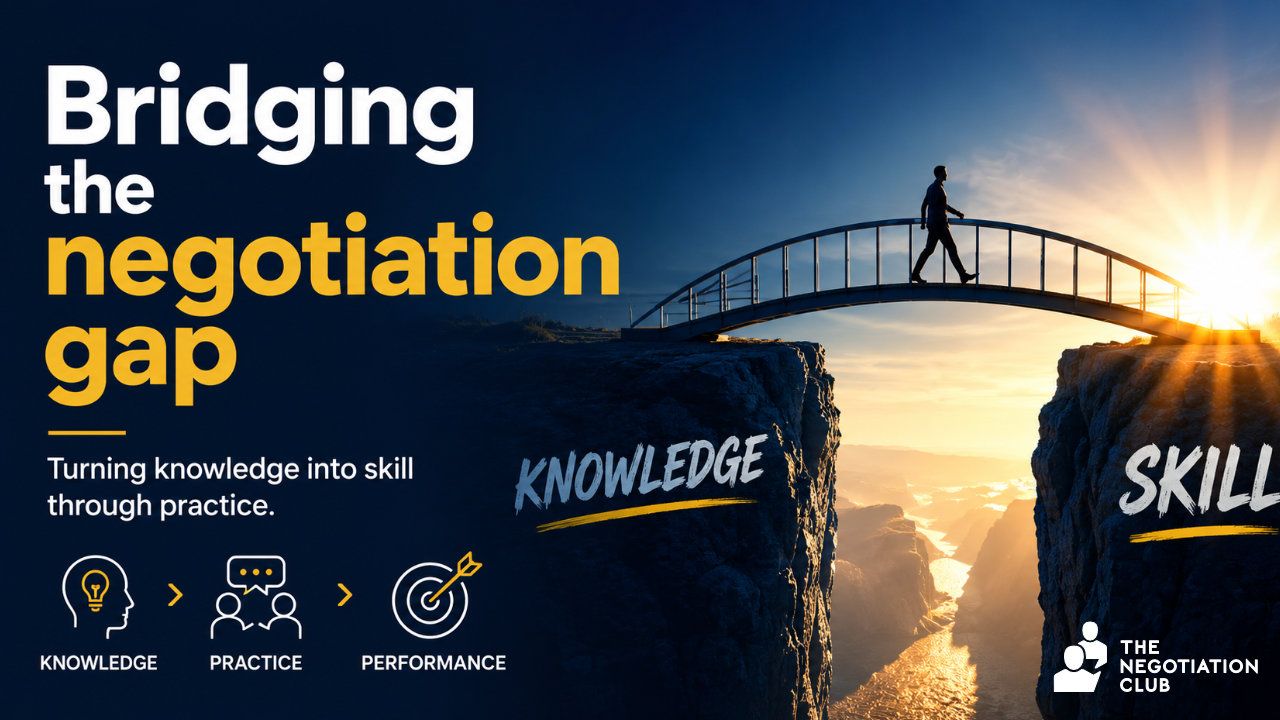
Bridging the Gap Partnership: Procurement Needs More Than Traditional Negotiation Training
Traditional negotiation training can help procurement teams learn. But learning is not the same as improving. The real challenge is bridging the gap between knowledge and skill through regular, deliberate practice.
Why Procurement Teams Need More Than Traditional Negotiation Training
Many procurement leaders invest in negotiation training because they want better commercial outcomes.
That seems to make perfect sense.... doesn't it?!
Negotiation is one of the most valuable skills a procurement team can develop. It can influence price, risk, supplier behaviour, contract value, service quality, innovation and long-term commercial relationships.
But here is the uncomfortable question:
If traditional negotiation training works so well, why do so many procurement teams still struggle to negotiate consistently?
The answer is not that training has no value..... It most certainly does!
The problem is that traditional training often stops too early. It gives people knowledge, frameworks and confidence for a short period of time, but it rarely creates the ongoing practice environment needed to turn that knowledge into reliable behaviour.
This is the real gap partnership procurement teams need to understand.
Not a partnership between a company and a training provider but a partnership between knowledge AND practice.
There Is A Gap Between Knowing and Doing
Most procurement professionals already know many of the basic principles of negotiation.
- They know they should prepare properly.
- They know they should ask better questions.
- They know they should listen carefully.
- They know they should avoid giving away concessions too early.
- They know they should understand the supplier’s position.
- They know they should consider alternatives, risk, value and leverage.
But knowing what to do is very different from doing it well under pressure.
That is where many traditional training programmes fail. They assume that because someone has understood a concept, they can now apply it effectively in a live supplier negotiation.
That is a very dangerous assumption.... Negotiation is not simply a knowledge-based activity. It is a behavioural skill.
And behavioural skills require practice!
Contact Us Here For More Information
Why Traditional Training Often Fails to Change Behaviour
Traditional training often gives people a burst of information in a very short period of time.
A team may attend a one-day workshop, a two-day course or an online programme. They may enjoy it. They may find it useful. They may even leave feeling motivated.
But then OMG ... they return to work and.....
- The inbox is full.
- Projects are urgent.
- Suppliers need answers.
- Stakeholders are chasing updates.
- Deadlines take over.
Within a few weeks, the training becomes a memory rather than a habit!
I have literally been there myself... great course but it's a losing battle if we unable to practice those lessons and that's why I started The Negotiation Club!
It doesn't mean the training was poor.... It means the organisation failed to create the next stage of development.
Training may introduce the skill, but practice develops the skill.
The Problem Is Not a Lack of Information
Procurement teams are not short of information. In fact there are so many negotiation books, videos, podcasts, articles, online courses, AI tools, templates, frameworks and models available everywhere.
In many ways, procurement professionals have more access to negotiation knowledge than ever before and yet that access to information has not automatically created better negotiators.
It seems stupid until you realise "Information is not the same as capability"...
- You can read about how to ride a bike.
- You can watch videos about swimming.
- You can attend a seminar on public speaking.
- You can listen to a podcast about leadership.
....But none of these things make you skilful unless you practise.
Negotiation follows the same rule.
The Vacuum Created by a Lack of Practice
When organisations fail to create viable opportunities for procurement teams to practise negotiation, a vacuum appears.
That vacuum is quickly filled by shortcuts. Companies begin looking for faster, easier solutions.
- They look for another model.
- Another framework.
- Another app.
- Another AI tool.
- Another quick course.
- Another checklist.
- Another clever acronym.
These tools can be useful. But they cannot replace human skill development.
The danger is that organisations start searching for shortcuts instead of addressing the fundamental issue: people need structured opportunities to practise.
Procurement Teams May Negotiate Less Than They Think
I have worked in procurement for over 30 years.... even my dad was a procurement professional and it boggles my mind when I hear the old phrase ... "We negotiate every day.".... Are we really?
- Or are they managing suppliers?
- Chasing responses?
- Handling internal stakeholders?
- Reviewing contracts?
- Answering emails?
- Solving operational problems?
These activities matter, but they are not always negotiation practice.
A major commercial negotiation may only happen a few times a year.
A strategic supplier negotiation may happen once every few years.
So the question becomes:
If your team only negotiates seriously a handful of times each year, when are they actually developing their negotiation skill?
Experience Alone Is Not Enough
There is a common belief that experience creates expertise.
Sometimes it does....Often it does not.
If someone repeats the same poor habits for ten years, they do not automatically become an expert. They become experienced at repeating the same habits.
Without feedback, reflection and deliberate practice, performance can plateau.
This is why one procurement professional with five years of experience may negotiate more effectively than someone with twenty years of experience.
The difference is not always time served.
The difference is how they have practised.
The Missing Partnership: Knowledge, Practice and Performance
This is where procurement teams need to rethink the idea of a GAP Partnership.
The real gap is between what people know and what they can do.
That gap is only closed when knowledge is partnered with practice.
A useful way to think about this is:
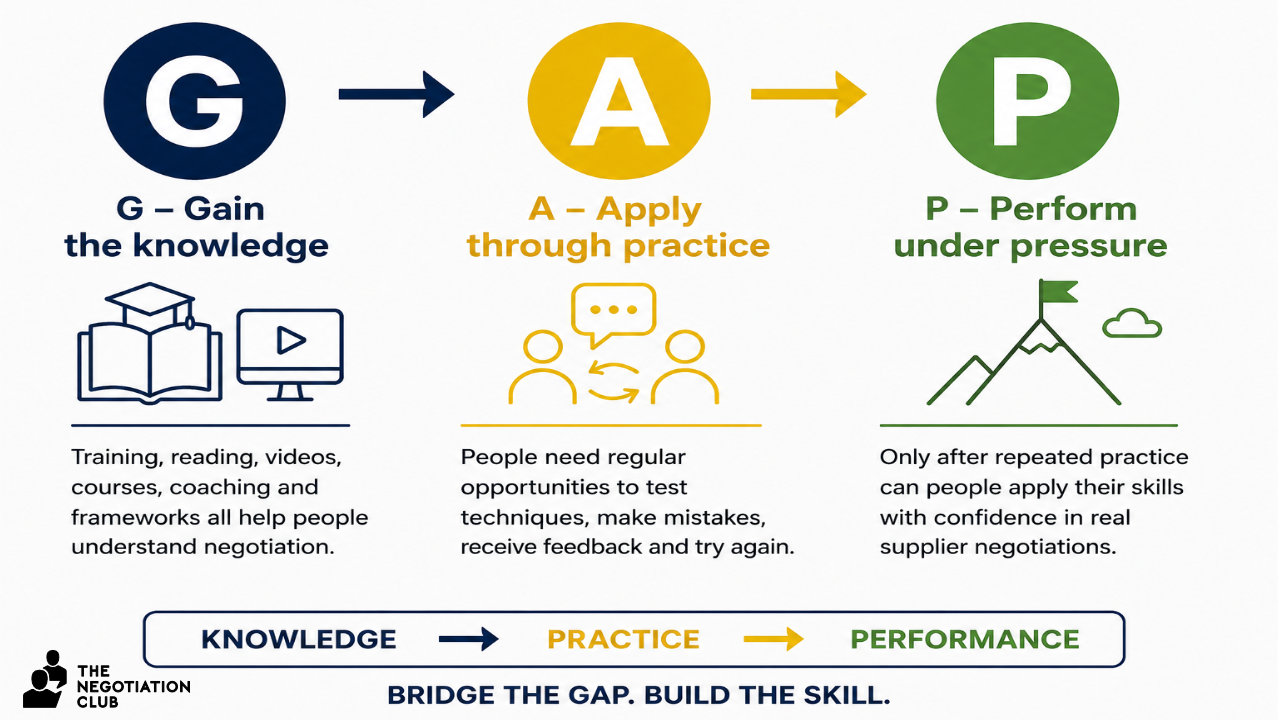
Most organisations invest heavily in the first stage.
They want the final stage.
But they often neglect the middle stage.
That is the problem.
Safe Practice Matters
Live supplier negotiations are not always the best place to learn because the stakes are too high.
- A poorly timed concession can cost money.
- A weak opening can damage leverage.
- A badly handled silence can create pressure.
- A missed question can lose valuable information.
- A defensive reaction can harm the relationship.
This is why procurement teams need safe practice environments.
They need somewhere to experiment, fail, reflect and improve before they sit across from a supplier.
Practice allows people to try different approaches without commercial risk.
- They can practise making proposals.
- They can practise using silence.
- They can practise challenging assumptions.
- They can practise asking better questions.
- They can practise managing pressure.
- They can practise saying no.
- They can practise observing others.
And most importantly, they can practise repeatedly.
Questions Every Procurement Leader Should Ask
If you lead a procurement team, ask yourself these questions honestly.
How often does your team deliberately practise negotiation?
I'm not talking about attending "training" or "talking" about negotiation.... but actually practising it.
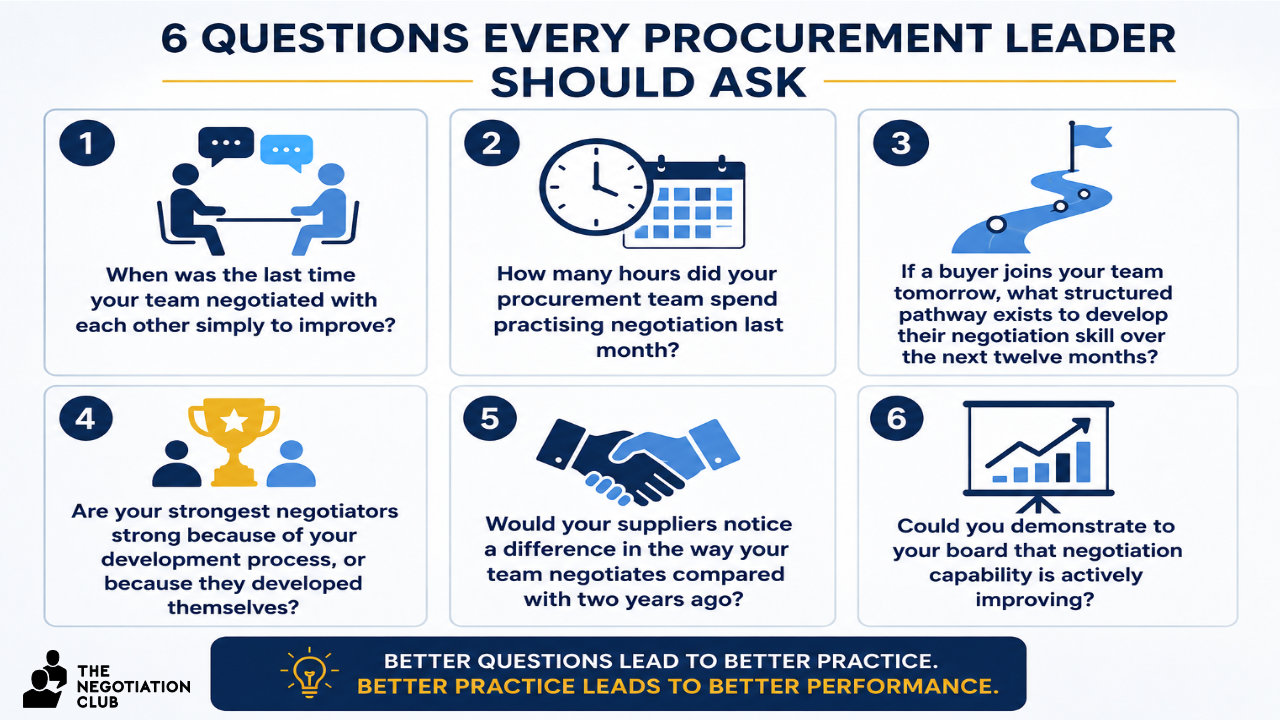
These are not comfortable questions but they are important ones.
The Risk of Outsourcing Skill Development to Shortcuts and AI
AI, online tools and digital learning platforms can all support negotiation development.
But they should not become a substitute for practice.
A procurement professional may ask AI how to handle a supplier price increase.
While that may produce useful ideas, it still requires the person to deliver the message. And perhaps this is my age, but it feels like communication skills have taken a battering. Great negotiators will still need ....
- To manage the supplier’s reaction.
- To ask the follow-up question.
- To hold their position.
- To think under pressure.
That is human performance and human performance has to be developed.
Procurement Needs Practice Communities
One of the most effective ways to close the gap between knowledge and skill is to create regular negotiation practice communities.
This could be an internal procurement negotiation club.
- It could be a monthly practice session.
- It could be a cross-functional commercial skills group.
- It could be a structured programme where buyers negotiate short scenarios, observe each other and give feedback.
The key is consistency!
One practice session will not transform a team but regular practice creates momentum.
People become more confident, more fluent and they will start noticing patterns in negoiations. They will improve their questioning and become far more comfortable with pressure.
You may have some great negotiators in your team and now ... they learn from each other.
And over time, negotiation becomes something they actively practise rather than something they only perform when the stakes are high.
What Should Procurement Teams Practise?
Procurement teams do not need long, complicated simulations every time.
In fact, short practice can be more effective because it allows people to focus on specific behaviours.
Teams can practise:
- Opening a negotiation clearly.
- Asking questions before making proposals.
- Handling a supplier price increase.
- Responding to “this is our final offer”.
- Making conditional concessions.
- Using silence effectively.
- Testing supplier assumptions.
- Managing internal stakeholder pressure.
- Creating movement without giving away value.
- Closing a negotiation professionally.
These are the small moments that determine negotiation outcomes.
They are also the moments that can be practised safely.
The Real Commercial Opportunity
For many organisations, the commercial opportunity is not simply buying another negotiation course.
The opportunity is creating a system where negotiation skill improves continuously.
That means moving from:
- Training event to practice habit.
- Knowledge transfer to behaviour change.
- Occasional learning to regular development.
- Individual confidence to team capability.
This is where procurement teams can build a genuine advantage.
Because most organisations still do not practise negotiation properly.
- They talk about it.
- They train it.
- They value it.
But they do not practise it often enough.
Here is my Final Question
While every procurement leader knows negotiation matters... knowing it matters ...is not enough!
The real question is:
"What are you doing right now to help your procurement team practise negotiation before their next important supplier conversation?"
If the answer is unclear, then the issue may not be your team’s motivation.
It may not be the quality of your previous training.
It may not be a lack of negotiation theory.
It may simply be that your organisation has not yet created the environment where negotiation skill can truly develop.
That is the gap.
..... And that is the partnership procurement teams need to build.
Knowledge starts the journey. Practice changes the behaviour. Performance follows.
Author


