
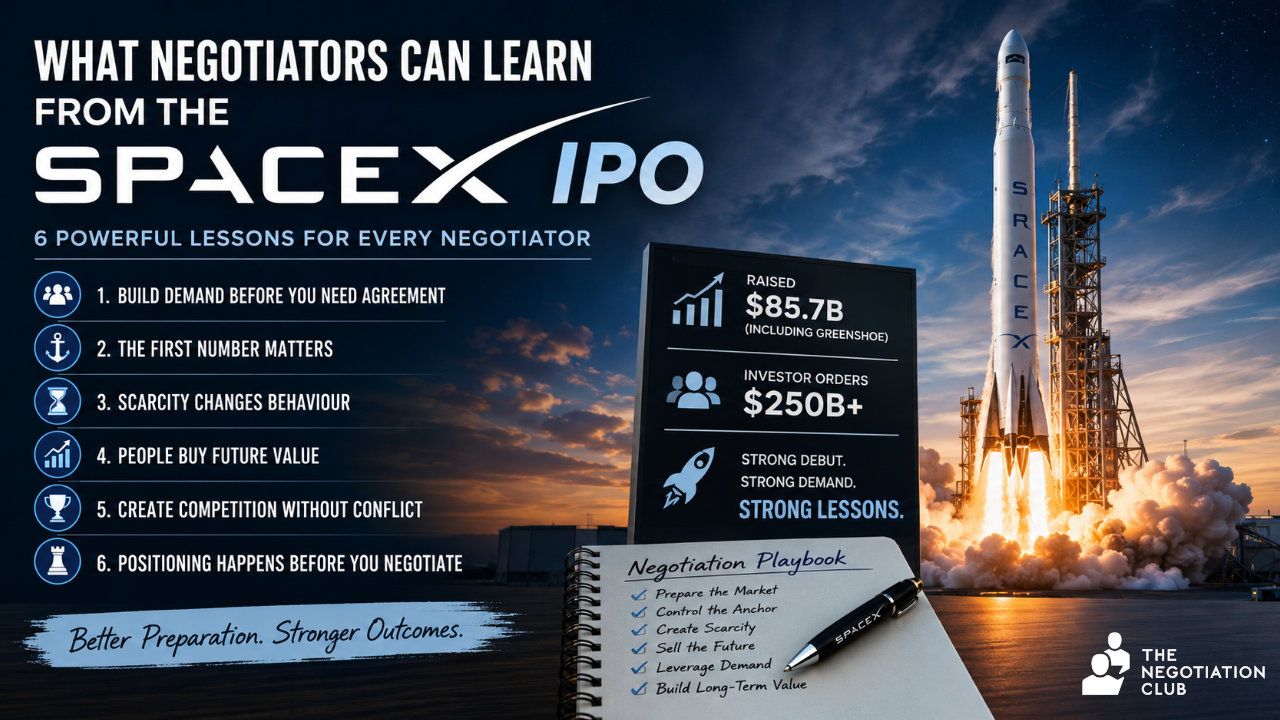
What Can Negotiators Learn from the SpaceX IPO?
When most people look at a major IPO, they focus on the money. Negotiators should be looking at something different: what can we learn from the way the deal was positioned, communicated, and brought to market?
Whether you are negotiating a supplier contract, a salary increase, a business acquisition, or a sales agreement, there are valuable lessons hidden inside some of the world’s biggest commercial transactions.
The recent SpaceX IPO provides several examples.
[The purpose of this article is not to analyse the stock market. It is to explore the negotiation principles that appear to have contributed to the success of the offering and how negotiators can practise those same principles safely before applying them in real-world situations.]
Lesson 1: Build Demand Before You Need Agreement
One of the most interesting aspects of the SpaceX IPO was that demand already existed long before the shares became available.
The IPO was not introducing SpaceX to the market. The IPO was providing access to something many people already wanted.
"Many negotiators spend their time preparing proposals. Far fewer spend time preparing demand."
When a proposal is introduced to a market that already wants what you offer, negotiations become significantly easier.
Practice safely: Run the same negotiation twice. In the first round, start immediately. In the second round, spend five minutes creating demand before the negotiation begins by explaining benefits, credibility, previous success, or unique value. Compare the outcomes.
Lesson 2: The First Number Matters
Reports suggested that SpaceX took a strong position on pricing rather than allowing the market to completely dictate the conversation.
The lesson for negotiators is clear: the first number introduced into a negotiation often becomes a reference point.
This is known as anchoring.
Once a number enters the discussion, future conversations frequently revolve around it.
The common mistake is assuming anchoring means making an extreme proposal. In reality, extreme anchors can damage credibility.
A more sophisticated approach is to establish reference points before discussing the actual variable.
Practice safely: Use a simple price negotiation card. Run three short negotiations. In round one, use no anchor. In round two, open with a direct proposal. In round three, introduce a reference point before discussing price, such as: “Most organisations we work with spend between £50,000 and £80,000 on projects like this.”
Lesson 3: Scarcity Changes Behaviour
Highly sought-after opportunities attract attention because people often place greater value on things that appear limited.
Scarcity does not need to be artificial. It simply needs to be genuine.
Examples include limited production capacity, restricted delivery slots, specialist expertise, unique product specifications, or fixed project timelines.
"The mistake many negotiators make is failing to communicate genuine scarcity."
Practice safely: Create two versions of the same negotiation. In one version, supply is unlimited. In the second version, availability is limited. Ask observers to watch whether urgency, questioning, proposals, or decision-making change.
Lesson 4: People Buy Future Value
With major market events, investors are not only evaluating what exists today. They are evaluating what something might become.
Negotiators face the same challenge.
People rarely buy only what something is. They buy what it could become.
A supplier may not be the cheapest today, but they may reduce future risk. A candidate may not have every skill today, but they may have the potential to become extremely valuable. A commercial partnership may not deliver immediate returns, but it may create strategic future advantage.
"The skill is to communicate future value without making unrealistic promises."
Practice safely: Ask participants to negotiate a service agreement. One group can only discuss current benefits. The other group must discuss future outcomes and long-term value. Observers should record which approach creates greater engagement.
Lesson 5: Create Competition Without Creating Conflict
When multiple parties want the same opportunity, negotiating leverage increases.
This does not mean negotiators need to become confrontational.
Competition and conflict are not the same thing.
Competition simply means there are alternatives.
"Strong negotiators understand how alternatives influence confidence, proposals, concessions, and decision-making."
Practice safely: Run the same negotiation three times. In the first version, neither side has alternatives. In the second version, both sides have alternatives. In the third version, only one side has alternatives. Compare confidence levels, concession patterns, and proposal strength.
Lesson 6: Positioning Happens Before the Negotiation Starts
Perhaps the biggest lesson is that much of the important work happens before the deal itself.
Reputation, credibility, preparation, relationships, and timing all influence how a proposal is received.
By the time you enter the negotiation, your previous actions may already be negotiating for you.
"The strongest negotiators do not simply prepare their proposal. They prepare the environment in which the proposal will be received."
Practice safely: Ask participants to negotiate the same scenario twice. In the first round, give no preparation time. In the second round, give ten minutes to prepare positioning. Ask: what do we want the other side to understand before we make our proposal?
Why Practice Matters
Most negotiators understand these concepts intellectually.
The challenge is not knowledge. The challenge is execution.
Knowing that anchors matter is different from using them effectively. Knowing that scarcity influences behaviour is different from communicating it naturally. Knowing that future value is important is different from explaining it convincingly under pressure.
"Negotiation skill improves when people practise, make mistakes, receive feedback, and try again."
This is why structured practice matters.
Footballers do not improve by attending one presentation each year. Musicians do not improve by reading about music. Negotiators do not become more effective simply by understanding negotiation theory.
They improve by practising the specific skills involved.
Whether you LOVE or HATE Elon Musk
The SpaceX IPO was not simply a financial event. It was a useful example of positioning, demand creation, scarcity, value communication, and market preparation.
Regardless of whether you negotiate supplier contracts, sales agreements, employment packages, legal settlements, or commercial partnerships, the principles remain remarkably similar.
"The strongest negotiators do not simply prepare their proposal. They prepare the environment in which the proposal will be received."
And like every other professional skill, the only reliable way to develop that capability is through deliberate, structured practice.
Author


