
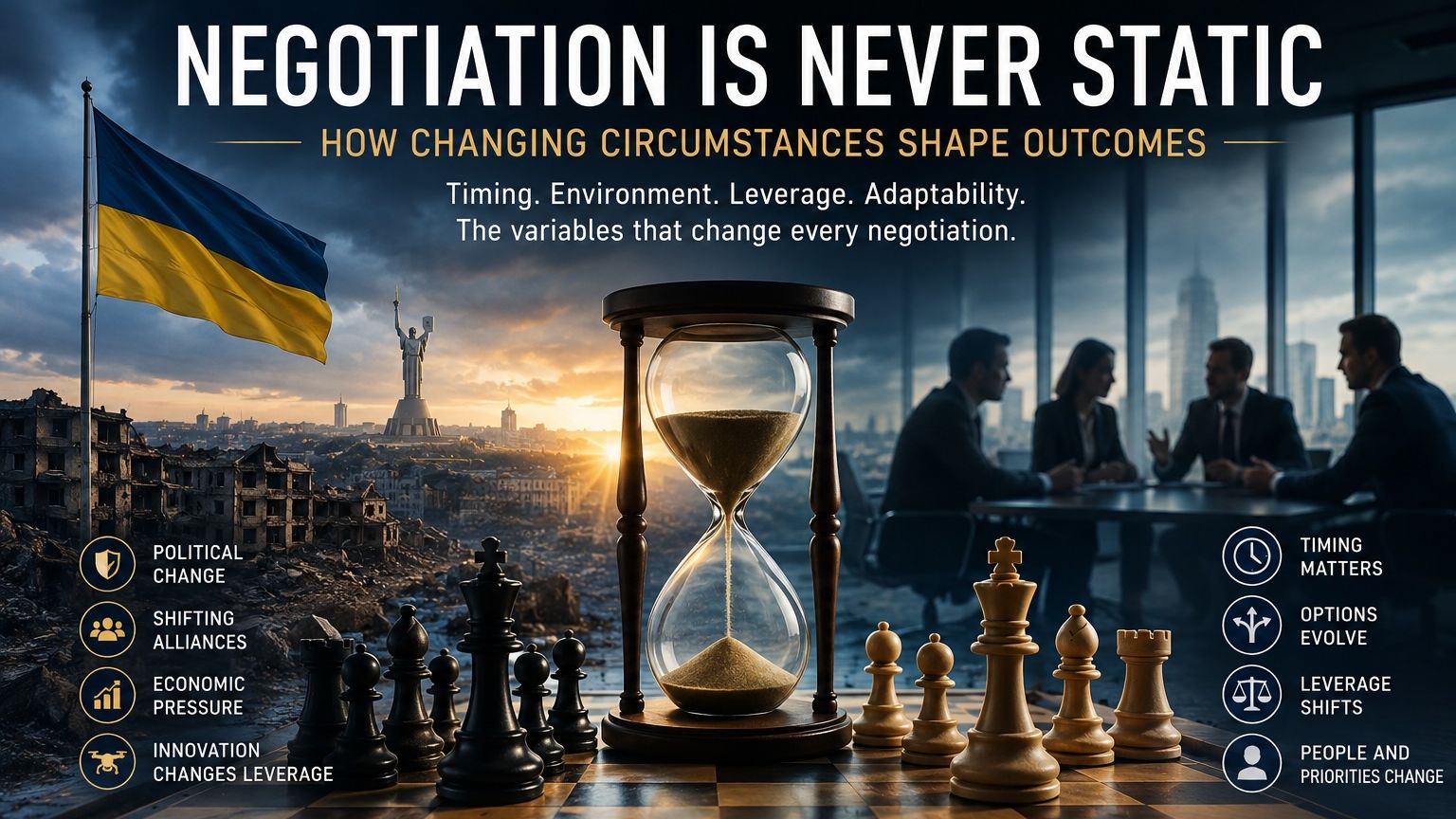
Why Negotiation Is Never Static
Negotiation does not happen in a static environment. It happens inside constantly changing conditions shaped by timing, politics, economics, capability, emotion and pressure. The same negotiation conducted at different moments in time can produce entirely different outcomes because the environment surrounding the negotiation is constantly evolving. Understanding this may be one of the most overlooked aspects of negotiation itself.
Change YOUR environment with a FREE Negotiation Session
Negotiation Is Influenced by More Than the Conversation
When many people think about negotiation, they imagine a meeting room, two opposing sides, and a conversation focused on reaching agreement.
But real negotiation is rarely that simple.
Negotiation does not happen in a static environment.
It happens inside constantly changing conditions.
The same negotiation conducted:
- in the morning instead of the afternoon,
- before an election instead of after,
- during economic growth instead of recession,
- before a technological breakthrough instead of after,
.... could produce an entirely different outcome!
And yet I have found many negotiation books and courses still present negotiation as though it exists in isolation from the wider environment around it.
The reality is that negotiation outcomes are often shaped by factors far beyond the discussion itself.
- Timing matters.
- Pressure matters.
- Politics matter.
- Capability matters.
.... And circumstances are always changing!
The Danger of Viewing Negotiation as Frozen in Time
One of the greatest mistakes negotiators make is assuming that the conditions surrounding a negotiation are fixed.
They are not.
- A rejected proposal today may become acceptable six months later.
- A supplier who appears dominant this year may suddenly become vulnerable next year.
- A customer who refuses to compromise in one quarter may become highly flexible in another because of budget pressure, competition, regulation, or internal leadership changes.
Even individuals themselves change:
- emotionally,
- financially,
- politically,
- professionally, and
- psychologically.
This means negotiation should never be viewed as a single isolated event.
It is part of a moving system.
Ukraine and the Changing Negotiation Environment
The ongoing war in Ukraine provides an extraordinary example of how dramatically negotiation environments can evolve over time.
Without taking a political position, the conflict demonstrates something negotiation professionals should pay close attention to:
"The conditions surrounding negotiations are constantly shifting."
When the conflict first escalated in 2022, assumptions were made globally about:
- military capability,
- political unity,
- economic resilience,
- dependency on external support,
- and likely long-term outcomes.
Yet over the following years, many of those assumptions changed.
- Political leadership changed.
- The position of the United States evolved from a Biden administration to a Trump administration.
- European political pressures shifted.
- Funding that at times appeared uncertain later became available.
- Public opinion changed across different countries.
- Economic conditions changed.
- Military capability changed.
But perhaps most fascinating from a negotiation perspective has been Ukraine’s rapid adaptation through necessity.
Initially perceived by many as heavily dependent on external support, Ukraine has increasingly developed domestic innovation in areas such as drone warfare, electronic systems, and low-cost defence capability.
In some areas, these systems have proven dramatically cheaper and more agile than traditional military approaches.
That innovation has not only altered battlefield dynamics .... It has altered leverage.
And leverage changes negotiations!
War as an Attempt to Change Negotiation Conditions
This may be uncomfortable to acknowledge, but throughout history wars have often been connected to negotiation pressure.
Not because negotiation disappears entirely, but because parties attempt to reshape the environment before returning to negotiation.
Conflict can become an attempt to:
- improve leverage,
- weaken resistance,
- influence political will,
- exhaust economic capability,
- strengthen alliances,
- or alter what each side believes is possible.
In effect, the environment itself becomes part of the negotiation.
That does not justify conflict.
But it does demonstrate how deeply connected negotiation outcomes are to changing conditions.
The Business Lesson Most People Miss
These same principles exist within business and personal negotiations.
A procurement negotiation may fail today because supply is tight.
Six months later, increased competition may completely change the balance of power.
A salary negotiation rejected in one quarter may succeed after restructuring, staff shortages, or market movement.
A business partnership may only become possible after trust, credibility, or capability develops over time.
Even internally within organisations, leadership changes can radically alter negotiation outcomes.
The negotiation itself may not have changed.
The environment around it has.
Sometimes the Best Move Is Not Immediate Pressure
Many negotiators become obsessed with forcing progress immediately.
But experienced negotiators often understand something more important:
"Sometimes the best strategy is to wait for circumstances to change."
Or to actively change them.
That might involve:
- building alternative options,
- developing new capability,
- strengthening relationships,
- investing in innovation,
- increasing credibility,
- creating competitive pressure,
- improving resilience,
- or simply allowing time to shift the balance.
In negotiation, patience is not passive.
.... Patience can itself be strategic!
Negotiation Is a Moving Environment
At The Negotiation Club, we often focus on practicing negotiation behaviours and skills because practice develops adaptability.
And adaptability matters because negotiation environments are never static.
The person who succeeds in negotiation is rarely the person who memorised the most tactics.
It is often the person who:
- observes changing conditions,
- recognises shifting leverage,
- adapts faster than others,
- and understands when the environment itself is changing.
Negotiation is not simply the conversation taking place at the table.
It is the interaction between:
- timing,
- pressure,
- capability,
- emotion,
- politics,
- economics,
- perception,
- and changing circumstances.
And sometimes the greatest negotiation skill is recognising that the conditions of today may not be the conditions of tomorrow.
Author


