
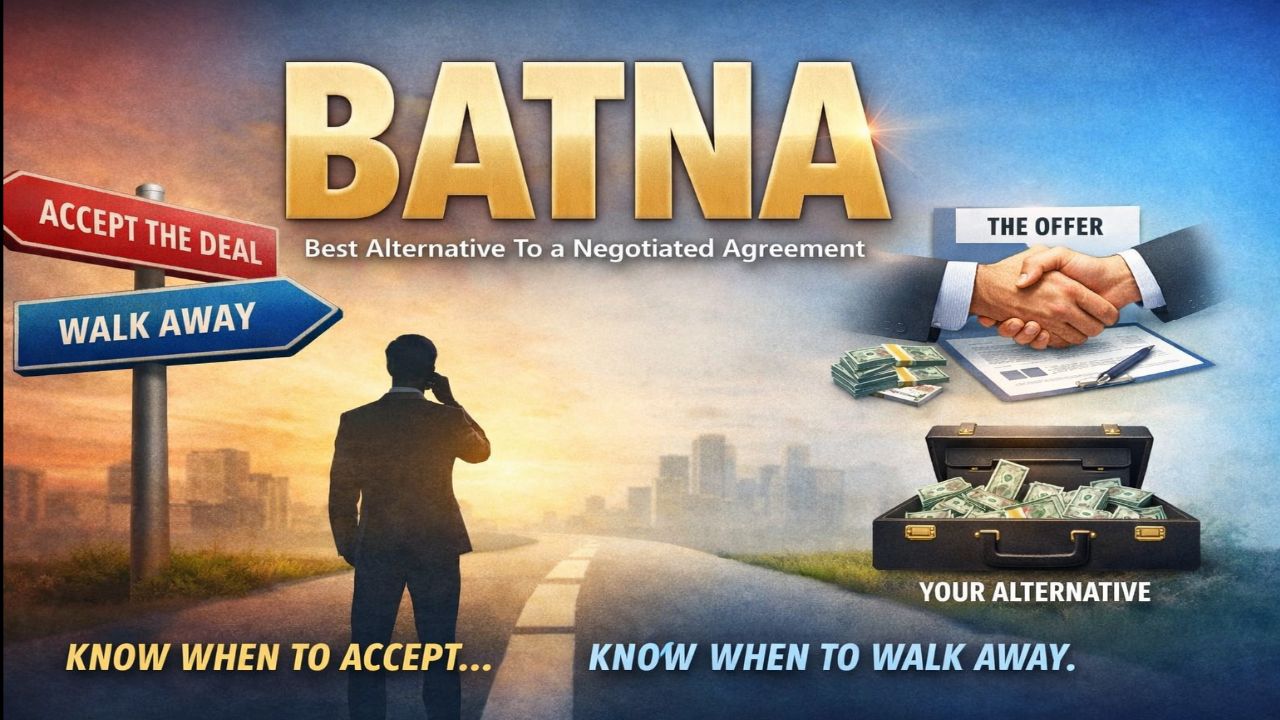
BATNA in Negotiation: The Skill That Stops You Agreeing to Bad Deals
If you strip negotiation back to its core, you’re making one decision over and over again:
“Is this deal good enough for me to say yes?”
A BATNA.... "Best Alternative To a Negotiated Agreement" .... gives you the answer.
Not in theory.
In practice.
What is a BATNA, really?
Most definitions stop at:
“Your best alternative if you don’t reach agreement.”
That’s correct, but incomplete.
A more useful way to think about it is:
Your BATNA is your decision benchmark.
It’s the standard that tells you:
- when to accept
- when to push
- when to walk away
Without it, you’re negotiating on instinct and emotion.
With it, you’re negotiating with intent.
Why BATNA matters
Let’s be direct.
Most poor negotiation outcomes don’t happen because people lack tactics.
They happen because:
- they don’t know what they’ll do if the deal fails
- they feel pressure to agree
- they accept something they later regret
A strong BATNA changes that.
Try It At The Student Negotiation Club
Practice BATNA in the Warwick Negotiation Club
Master BATNA at the Gold Negotiation Club
1. It removes desperation
Without a BATNA:
“I need this deal”
With a BATNA:
“I have options”
That shift alone changes behaviour.
2. It creates discipline
A BATNA gives you a clear line:
“Anything worse than this — I walk away.”
This is where many people struggle. Not knowing the concept, but using it under pressure.
3. It improves your outcomes
Not because you “win harder”.
But because:
You stop agreeing to bad deals.
That’s a very different skill.
What makes a good BATNA?
Not all alternatives are equal.
Weak BATNA
- Vague: “I’ll find something else”
- Worse than your current negotiation
- Uncertain or untested
Result: you’ll still feel pressure to agree.
Strong BATNA
- Specific, with clear terms and clear value
- Credible, because you can actually execute it
- Close in value to your preferred deal
Result: you negotiate with control.
Critical point:
“A strong BATNA doesn't mean you won't do a deal. It means you will only doa good one”
A Simple BATNA Example
You want to buy a car.
- Seller wants: £14,000
- You want to pay: £12,000
Without a BATNA:
- you negotiate
- you feel pressure
- you agree at £13,000
Deal done.... But not a great one.
Now introduce a BATNA.
You find another car:
- £9,200
- slightly less ideal, but acceptable
Now your thinking changes:
“Is this car worth more than £2,800 extra to me?”
If not, you walk.
That is BATNA in action.
The most common misunderstanding
Many people think:
“BATNA gives me power over the other person.”
It doesn’t.
BATNA gives you control over your own decisions.
That’s far more important.
Where people go wrong
1. They don’t define it clearly
A vague alternative is not a BATNA.
2. They don’t improve it
If your BATNA is weak, improve it before you negotiate.
More options lead to better decisions.
3. They ignore it under pressure
This is the big one.
They have a BATNA and still agree to something worse.
That’s not a knowledge problem.
That’s a practice problem.
How to practise BATNA properly
Reading about BATNA won’t help much.
You need to experience the moment where you should walk away.
Here are practical ways to practise that skill using The Negotiation Club DIGITAL Negotiation Cards
PRACTICE EXERCISE 1: Two deals, one choice
Objective: learn to use a real BATNA as a benchmark.
Resource: Use the THREE x Variable Digital Negotiation Cards
Step 1
Run a short negotiation and reach a deal.
Step 2
Treat that deal as your BATNA.
It is still available.
Step 3
Run a second negotiation with a different person (Keep the same Digital Negotiation card for a second negotiation)
Step 4
At the end, choose:
- Deal 1
- or Deal 2
No blending.
What you learn
- whether you stick to your standard
- whether you get drawn into a worse deal
- how your behaviour changes when you have an alternative
PRACTICE EXERCISE 2: Define your walk-away point
Objective: remove ambiguity.
Resource: Use the THREE x Variable Digital Negotiation Cards
Before negotiating, write:
- My current option is: ______
- I will walk away if: ______
Be specific:
- price
- terms
- trade-offs
What you learn
Clarity improves decision-making.
Vague thinking leads to weak outcomes.
PRACTICE EXERCISE 3: Improve your BATNA
Objective: strengthen your position before negotiating.
Ask:
- What else could I do if this fails?
- Who else could I negotiate with?
- Can I delay, split, or change the deal?
What you learn
Negotiation doesn’t start at the table. It starts with your options.
PRACTICE EXERCISE 4: Multi-variable BATNA
Most real negotiations are not just about price.
Example
Your current deal:
- £8,200
- 30-day payment
- high quality
New deal:
- £8,500
- 60-day payment
- medium quality
Now ask:
“Is this better?”
There’s no obvious answer.
What you learn
- how to weigh trade-offs
- what matters most to you
- how to avoid defaulting to price
Let Us Leave You To Ponder This...
The best negotiators are not the ones who push the hardest.
They are the ones who know:
- what a good deal looks like
- what a bad deal looks like
- and when to walk away
For a more academic definition of BATNA, see this explanation from Harvard’s Program on Negotiation.
Bringing BATNA into practice
Understanding BATNA is useful.
Practising it is transformative.
At The Negotiation Club, this is exactly what we focus on:
- short, structured negotiations
- real alternatives
- clear decision points
- feedback on behaviour, not just outcomes
Because the real question isn’t:
“Do you know what a BATNA is?”
It’s:
“Will you use it when it matters?”
If you want to build that skill, join a session and experience it for yourself.
Practice your BATNA in a Negotiation Club:
Join a FREE Negotiation Taster Session
Join the Student Negotiation Club (£9.99 pm)
Author


