
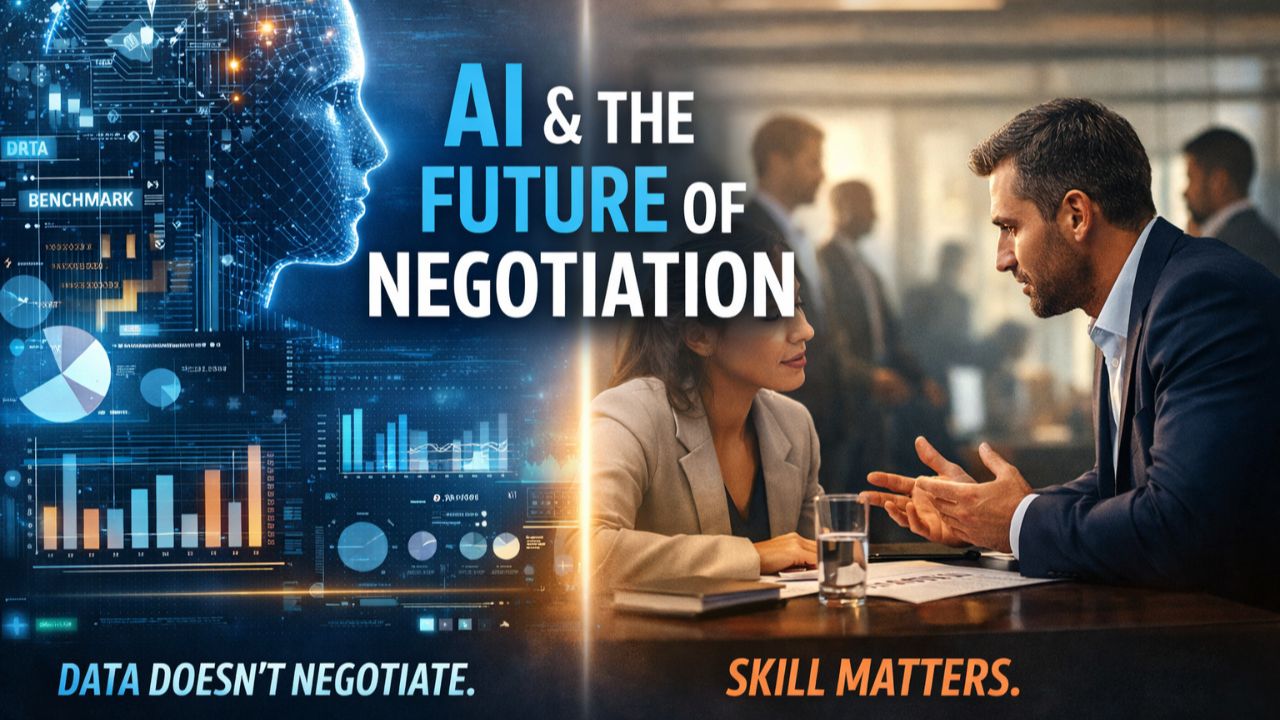
AI, Transparency & The Myth of the “Naked Negotiation”
Artificial intelligence is transforming negotiation by increasing transparency and reducing information asymmetry... but true competitive advantage still depends on human negotiation skills, behavioural intelligence and deliberate practice.
We are told that we have entered a new era....
- AI has killed information asymmetry.
- Data is public infrastructure.
- Margins can be modelled.
- Prices can be benchmarked in an instant
- We are ... “negotiating naked”.
It is a compelling narrative.....But I would argue it is also incomplete.
Because while information has become more transparent, negotiation skill has not automatically improved. In fact, I would suggest there is a credible argument that the opposite may be happening.
Practice it at a FREE Negotiation Taster Session
Has AI Killed Information Asymmetry?
It is incredible how AI has dramatically reduced surface opacity because in this day and ager we can:
-
Benchmark supplier pricing in minutes
-
Model margin logic using publicly available data
-
Compare market alternatives instantly
-
Generate negotiation scripts and concession pathways
-
Analyse historic contract patterns
In commercial negotiations, particularly procurement and sales negotiations, this is significant.
However, I don't believe information asymmetry has disappeared., I see it shifting.
That's because AI is not omnipotent, AI cannot see:
-
Internal political constraints
-
Urgent deadlines hidden from the other party
-
Authority limits
-
Personal incentives
-
Emotional drivers
-
Risk tolerance
-
Reputation concerns
Those variables remain private.
Negotiation has never been purely about data. It has always been about interpretation, timing, behaviour, and response under pressure.
I agree that transparency affects preparation but it does not remove human complexity.
Is the “Strongman Negotiator” Obsolete?
I have seen a number of posts popularising the argument that AI transparency makes "dominance" negotiation redundant.
The theatrical negotiator who:
-
Anchors aggressively
-
Intimidates
-
Raises their voice
-
Pounds the table
-
Relies on mystique
…is supposedly running out of oxygen.
There is truth here but I don't see this purely because of AI. Dominance-based negotiation have been declining for some time because:
-
Markets are more interconnected
-
Reputation travels quickly
-
Counterparties are more educated
-
Long-term commercial relationships matter more
The shift is cultural because people tolerate intimidation less than they used to.
- But power imbalances still exist.
- Deadlines still exist.
- Alternatives still exist.
- Authority dynamics still exist.
Aggression has never been a substitute for skill even though it can deliver results (Although I will concede there is a skill in controlled aggression). So the real evolution is not from gladiator to architect... it is from opacity to visibility.
And visibility increases the importance of behaviour!
The Hidden Risk: Skill Atrophy
Here is the uncomfortable question.
While we celebrate AI preparation tools, are we quietly losing interpersonal negotiation capability?
Consider the timeline:
-
Email reduced the need for live, face-to-face difficult conversations.
-
Social media encouraged performative communication over constructive disagreement.
-
Remote working reduced informal exposure to real-time commercial negotiation.
-
AI now drafts arguments, prepares scripts and structures proposals.
Each innovation increases efficiency.
But each also reduces friction.
Negotiation skill develops through friction.
-
Through awkward silence
-
Through emotional pushback
-
Through rejection
-
Through live objection handling
-
Through the discomfort of not knowing what to say next
If fewer professionals experience high-friction negotiation moments, then fewer develop resilience and adaptability.
Access to data is increasing.... but .... live negotiation reps may be decreasing.
That is not a generational criticism. It is an experiential observation and a reason to practice like never before.
Millennials, Gen Z and the “Data Advantage”
It is often argued that younger professionals are naturally advantaged because:
-
They are comfortable with data
-
They question authority
-
They research rapidly
-
They challenge assumptions
-
They dislike theatrical dominance
These may be strengths but negotiation is not won by data comfort alone. It is won through:
-
Structured concession strategy
-
Silence discipline
-
Authority management
-
Real-time reframing
-
Multi-variable trade construction
Being raised in a data-rich world does not automatically create negotiation fluency. In fact, if AI increasingly provides the structure, the real differentiator becomes live execution.
"When everyone can generate a strategy document, the advantage shifts to those who can execute under pressure."
Data Does Not Negotiate. People Do.
AI can:
-
Suggest anchors
-
Model pricing ranges
-
Draft concession ladders
-
Analyse historical contracts
-
Generate objection responses
AI cannot:
-
Read hesitation in someone’s voice
-
Detect emotional rejection
-
Sense when silence is uncomfortable
-
Decide when to push and when to pause
-
Build trust through presence
-
Manage ego in the room
Negotiation remains a behavioural discipline and especially when information equalises, behaviour differentiates.
In a fully transparent environment:
-
Listening becomes rarer
-
Calm becomes rarer
-
Structured thinking becomes rarer
-
Discipline becomes rarer
Those who practise these skills gain disproportionate advantage.
The Real Future: Visible Architecture + Live Skill
The popular framing is “Stop training gladiators. Start building architects.” but this is partially correct.
Negotiation requires design:
-
Clear variable identification
-
Trade mapping
-
Structured preparation
-
Scenario modelling
-
Authority awareness
-
Outcome planning
But architecture without live skill collapses under pressure.
The real future belongs to:
Architects who can perform.!
Professionals who:
-
Prepare using AI intelligently
-
Structure variables clearly
-
Anticipate objections
-
Then execute calmly, precisely and adaptively in the room
Transparency through AI does not weaken negotiation -but I think it certainly raises the standard.
The Real Risk: Outsourcing Thinking
I genuinely don't believe AI is a threat but we tread on dangerous ground when we fall into the trap of passive reliance.
And it is getting harder and harder not to fall into temptation:
-
Copy negotiation scripts without understanding them
-
Rely on AI anchors without sensing reaction
-
Avoid live negotiation in favour of email
-
Delegate difficult conversations to written channels
THIS is when skill erosion becomes real.
But this is not inevitable.
AI can deepen preparation.
It cannot replace deliberate practice.
TRY it at a FREE Negotiation Taster Session
Why Negotiation Practice Matters More Than Ever
In a world where:
-
Data is accessible
-
Benchmarks are visible
-
Margins are modelled
-
Alternatives are transparent
… the differentiator becomes behavioural precision.
Negotiation is not theatre.
It is not intimidation.
It is not ego.
It is structured problem-solving under pressure.
And like any high-performance skill, it requires repetition.
Not theory.
Not reading.
Not watching.
Practising....
-
Practising silence
-
Practising summarising
-
Practising objection handling
-
Practising multi-variable trade-offs
-
Practising authority positioning
-
Practising emotional regulation
If the other party has the same data, you cannot rely on information advantage then you must rely on skill to tip the balance.
We Are Not Negotiating Naked
While AI has changed preparation it has not replaced performance. After 30 years in procurement I have seen first hand how technology impacts the negotiation arena and so our question should not be whether the old world is coming back. The real question is:
Who is deliberately training to negotiate well in the new one?
Because when information equalises, execution wins..... And execution is built through structured, repeated practice ... not algorithms.
Join a FREE Negotiation Taster Session
Join the Student Negotiation Club (£9.99 pm)
Author


