
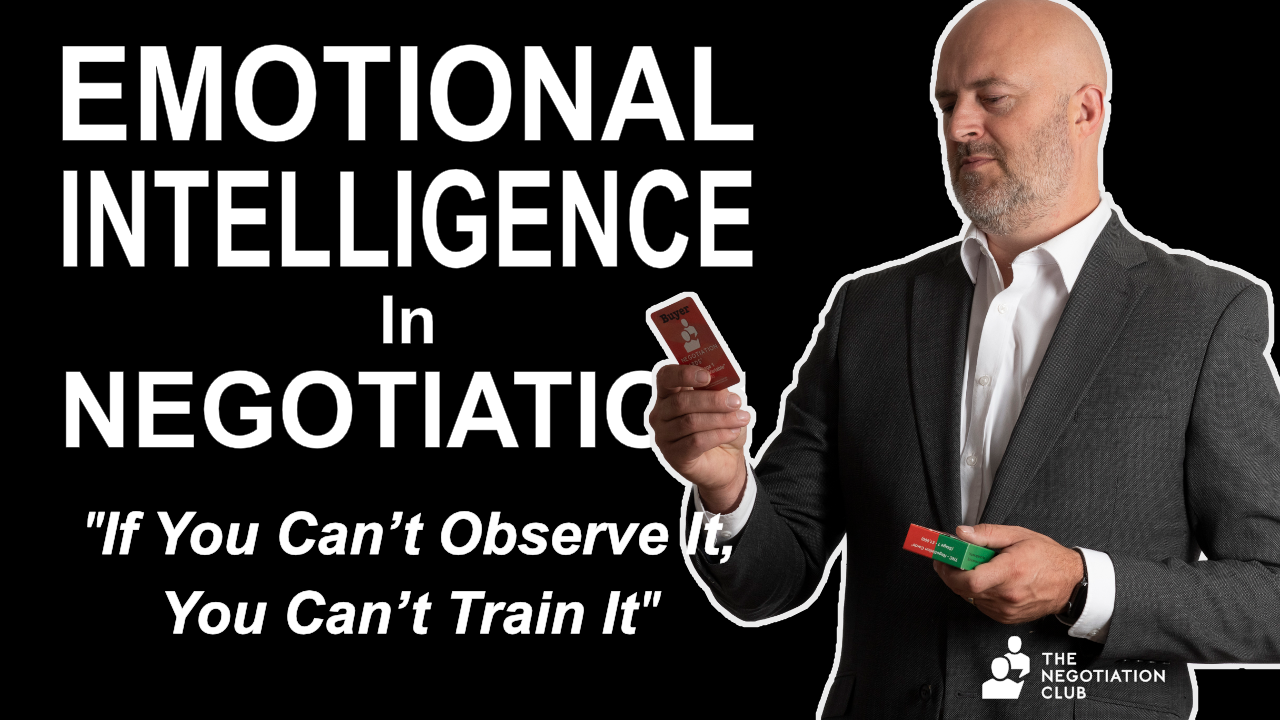
Emotional Intelligence in Negotiation: Why It Is Not a Tactic (Until You Practise It)
Emotional Intelligence is frequently described as a critical negotiation skill, yet it is also one of the most misunderstood.
It is often treated as a personality trait — something you either “have” or “don’t have”. In negotiation, that assumption is not just unhelpful, it actively prevents improvement.
Join a FREE Negotiation Taster Session
What Emotional Intelligence Actually Means in a Negotiation
In its most credible research-based form, Emotional Intelligence refers to the ability to process emotional information and use it in reasoning and decision-making.
Emotional Intelligence in negotiation is not a vague soft skill. It is the ability to notice emotional information, interpret it accurately, and choose an appropriate response under pressure.
That means Emotional Intelligence only becomes meaningful when it is translated into observable, practisable behaviours. Without that translation, it remains a label rather than a skill.
In a negotiation context, this involves four practical capabilities:
- noticing emotional signals in yourself and others
- understanding what those signals are likely to mean
- regulating your own emotional responses
- influencing the emotional climate so that problem-solving can continue
Crucially, none of these are internal feelings. They are behaviours.
If Emotional Intelligence cannot be observed, it cannot be practised.
If it cannot be practised, it cannot be improved.
Why Emotional Intelligence Fails in Most Negotiation Training
Most negotiation training treats Emotional Intelligence as a concept to understand rather than a skill to rehearse.
Common advice includes:
- “Be empathetic”
- “Read the room”
- “Manage emotions better”
The problem is simple: none of these instructions tell a negotiator what to do in the moment.
When a proposal is emotionally rejected, or tension rises unexpectedly, negotiators do not fail because they lack awareness. They fail because they lack trained responses.
Emotional Intelligence Is Not a Single Tactic
Emotional Intelligence should not sit on a single tactic card.
It functions far better as a capability layer that governs how and when multiple tactics are used.
In practice, Emotional Intelligence is revealed through micro-moments:
- observation
- timing
- restraint
- choice of language
- control of pace
- emotional accuracy in summaries and questions
The Negotiation Club already teaches many of the behaviours that collectively are Emotional Intelligence — they simply need to be understood as a connected system rather than isolated techniques.
Join a FREE Negotiation Taster Session
Observation: The Foundation of Emotional Intelligence
Every emotionally intelligent response begins with observation.
In negotiation, observation is not limited to body language. It includes noticing:
- changes in pace or tone
- repeated phrases
- hesitations or over-certainty
- emotional withdrawal after a proposal
- defensive language that does not align with logic
Without observation, Emotional Intelligence becomes guesswork.
This is why Observation is treated as a core negotiation skill at The Negotiation Club and practised deliberately, not assumed.
Pause, Consider, Respond: Emotional Self-Regulation in Action
Most Emotional Intelligence failures occur not because negotiators misread the other party, but because they fail to regulate themselves.
When faced with emotional resistance, the instinctive response is often to justify, explain, fill silence, or push harder.
The Pause, Consider, Respond tactic interrupts this cycle.
A brief pause creates space to avoid escalation, choose a better question, and resist the urge to “sell”.
Positive Regard: Keeping the Other Party Talking Without Conceding
Positive Regard is frequently misunderstood as agreement. It is not.
It is the deliberate use of neutral verbal and non-verbal signals that encourage the other party to continue speaking while you retain your position.
From an Emotional Intelligence perspective, Positive Regard reduces threat, lowers defensiveness, and maintains information flow.
Emotions and Rejection: Emotional vs Logical Resistance
One of the most practical applications of Emotional Intelligence in negotiation is recognising the difference between logical rejection and emotional rejection.
Treating emotional rejection as logical rejection is one of the fastest ways to damage a negotiation.
This distinction sits at the heart of the Emotions tactic and is practised extensively in Negotiation Club sessions.
Questioning as Emotional Calibration
Questions are not only information-gathering tools. They are emotional calibration tools.
Emotionally intelligent negotiators switch deliberately between:
- Open Questions to create space and autonomy
- Closed Questions to restore clarity
- T.E.D. Questions to deepen explanation
Summarising: Emotional Accuracy, Not Just Factual Accuracy
Summarising is one of the clearest indicators of Emotional Intelligence in a negotiation.
A strong summary captures not just what was said, but why it matters.
This is why Summarising is treated as a core skill rather than a closing technique.
Building Relations Before Emotion Appears
Emotional Intelligence is not purely reactive.
Early investment in Build Relations and LinkedIn Rapport reduces the likelihood that later proposals will trigger emotional resistance.
How Emotional Intelligence Is Practised at The Negotiation Club
Emotional Intelligence is not taught as theory. It is trained through:
- short, time-pressured negotiations
- observer-led behavioural feedback
- constraints that force emotional control
- repeated exposure to emotional rejection scenarios
The objective is not to “win” the negotiation, but to remain effective when emotion is present.
Emotional Intelligence Is a Skill You Can Train
Emotional Intelligence in negotiation is not something you possess.
It is something you practise.
And like all negotiation skills, it improves fastest when broken down into observable behaviours, trained deliberately, and reviewed honestly.....
Join a FREE Negotiation Taster Session
Join the Student Negotiation Club (£9.99 pm)
Author


