
“Respect is a tactic when used deliberately.”
How To Use A 'Positive Regard' Negotiation Tactic.

What is a “Positive Regard” in the Negotiation Context?
In negotiation, Positive Regard is the deliberate and visible demonstration that you respect the other party as a legitimate decision-maker, even when you disagree with their position, proposal, or constraints.
Used well, Positive Regard:
- Lowers emotional resistance
- Increases willingness to share information
- Reduces defensive rejection of proposals
- Creates space for movement without concession
Used poorly, it becomes flattery, weakness, or noise.
Positive Regard is not about being nice.
"It is about controlling how the other party feels about engaging with you while you continue to negotiate firmly."
Why Positive Regard Works in Negotiation
Negotiations are rarely rejected on logic alone.
More often, proposals are rejected because the person presenting them is perceived as:
- Dismissive
- Threatening
- Arrogant
- Unreasonable
- Uninterested in the other party’s constraints
Positive Regard directly addresses this.
When a negotiator feels:
- Listened to
- Respected
- Taken seriously
They are significantly more open to:
- Explaining their constraints
- Exploring alternatives
- Staying engaged when pressure increases
This makes Positive Regard a position-preserving tactic, not a concession strategy.
What Positive Regard Is NOT
To use this tactic correctly, it is important to be clear about what it is not.
Positive Regard is not:
- Complimenting for the sake of it
- Agreeing with weak or unacceptable positions
- Over-using praise
- Trying to be liked
- Softening your objectives
A negotiator can apply strong pressure, reject proposals, and hold firm positions while still demonstrating Positive Regard.
Common Examples of Positive Regard in Negotiation Language
Positive Regard is expressed through short, controlled statements, not long explanations.
Examples include:
- “I understand why that matters to you.”
- “That’s a reasonable concern from your side.”
- “I can see the logic in how you’re thinking about this.”
- “I appreciate you explaining the constraint.”
- “I don’t agree with the proposal, but I understand the rationale.”
Notice the structure:
- Recognition first....
- Disagreement (if needed) second
This sequencing is critical.
Where Positive Regard Is Most Effective
Positive Regard is particularly powerful in high-risk moments, including:
1. After a Proposal Is Rejected
Acknowledging the other party’s reasoning reduces emotional escalation and keeps the discussion open.
2. Before Applying Pressure
Demonstrating respect before introducing a firm position reduces perceived threat.
3. When Emotions Are Rising
Positive Regard can stabilise the interaction without backing down.
4. During Deadlock
It reframes the problem as shared rather than adversarial.
Positive Regard vs Empathy
These are often confused.
- Empathy is understanding how someone feels
- Positive Regard is showing that understanding in a way that influences behaviour
In negotiation, Positive Regard must be:
- Visible
- Deliberate
- Timed
Unexpressed empathy has no tactical value.
Risks of Overusing Positive Regard
Like many negotiation tactics, Positive Regard can lose impact if misused.
Common risks include:
- Sounding rehearsed
- Diluting strong messages
- Creating ambiguity about your position
- Appearing indecisive
"This is why practice is essential. The skill is not knowing what to say, but knowing when and how often to use it."
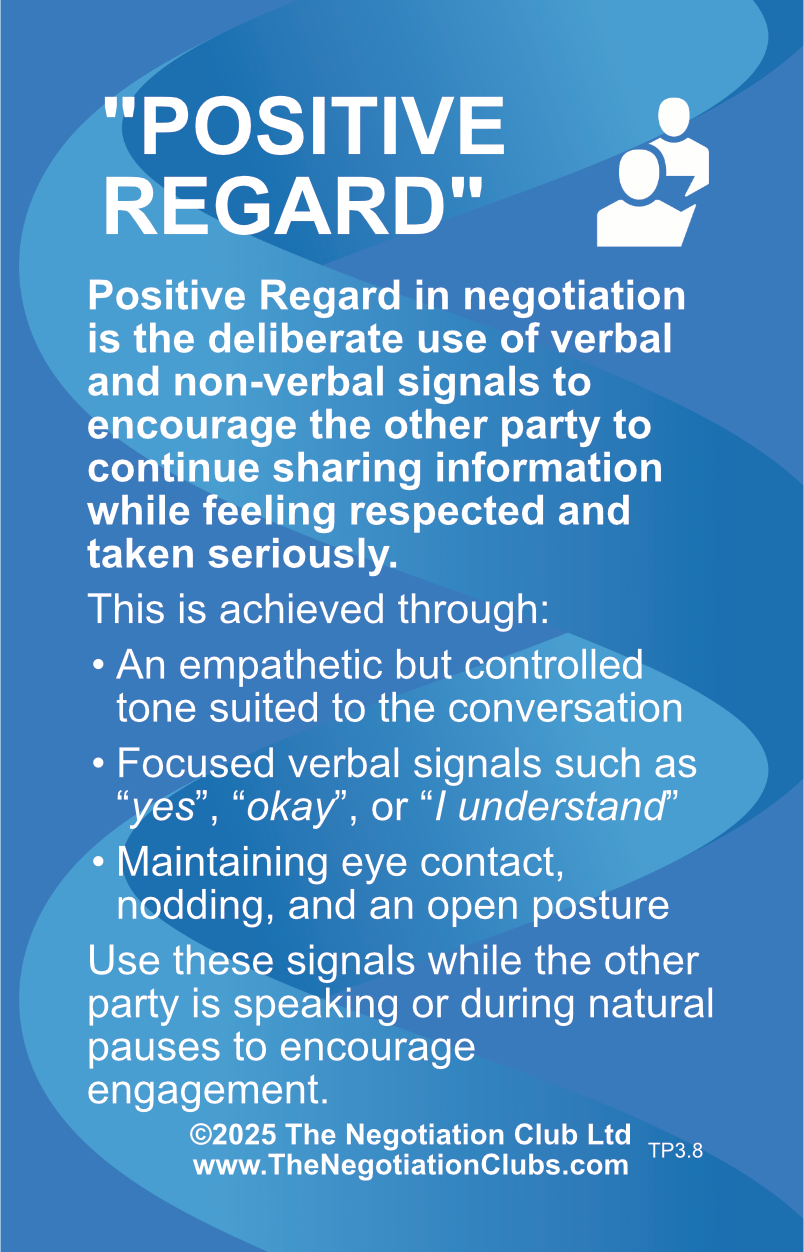
Introducing the Positive Regard Negotiation Card
The Positive Regard Negotiation Card is designed to turn respect from an intention into an observable, practised negotiation skill.
Used in short, timed negotiations, the card helps participants practise:
- Acknowledging the other party without conceding
- Sequencing regard before pressure
- Maintaining engagement during rejection
- Staying controlled under emotional pressure
Add this card to your deck and refine your ability to uncover the other side’s limits with precision and subtlety.
How to Practise Positive Regard (Negotiation Club Method)
Positive Regard is best practised in short, focused negotiations, not full role-plays with multiple objectives.
Practice Exercise 1: Constraint Acknowledgement
Objective:
Practise acknowledging constraints without conceding.
Rules:
- One variable only (e.g. price or budget)
- Buyer must reject at least two proposals
- Seller must respond using Positive Regard before any counter
Observer Focus:
- Was regard expressed clearly?
- Was it concise?
- Did it reduce tension or increase clarity?
Practice Exercise 2: Disagreeing With Respect
Objective:
Practise rejecting proposals while maintaining engagement.
Rules:
- Negotiator must say “no” three times
- Each rejection must include a form of Positive Regard
- No justification longer than one sentence
Observer Focus:
- Tone
- Sequencing
- Emotional impact on the other party
Practice Exercise 3: Pressure With Regard
Objective:
Apply pressure immediately after expressing Positive Regard.
Rules:
- Positive Regard statement
- Immediate firm position or boundary
- No hedging language allowed
Example:
“I understand why you’re pushing for that, and we can’t accept it at that level.”
Observable Skill Levels
At The Negotiation Club, we assess Positive Regard using observable behaviour.
Level 1 – Awareness
- Attempts to sound respectful
- Language is inconsistent
- Often mixed with over-explanation
Level 2 – Integration
- Clear, concise expressions
- Used at appropriate moments
- Does not weaken position
Level 3 – Control
- Used deliberately under pressure
- Improves information flow
- Stabilises difficult negotiations
Why Positive Regard Must Be Practised
Most negotiators believe they show respect.
Very few do so consistently, visibly, and under pressure.
Positive Regard is a behavioural skill, not a mindset.
It only becomes effective through:
- Repetition
- Feedback
- Observation
"This is why it is practised explicitly within Negotiation Club sessions rather than taught as a concept."
Check Your Knowledge
If you can answer each question, you're already halfway to success!
The next step is simple: just PRACTICE.
1. Is Positive Regard the same as agreeing with the other party?
2. When should Positive Regard be used in a negotiation?
3. Can Positive Regard weaken my negotiating position?
4. What language works best for demonstrating Positive Regard?
5. How do non-verbal signals support Positive Regard?
6. How do you practise Positive Regard effectively?
Practicing at The Negotiation Club
Understanding negotiation tactics and techniques is just the first step because their effective application always require... practice! This is where negotiation clubs or practice groups can be invaluable so JOIN our club today and get a 30 Day FREE Trial!


Club Members Giving Constructive Feedback
At The Negotiation Club, the Observer plays a critical role in how negotiation skills are developed through practice.
During each practice negotiation, the Observer focuses on the execution of a specific tactic, not the outcome of the negotiation. Their role is to watch what actually happens in real time—how the tactic is attempted, how it is delivered, and how the other party responds.
Feedback is structured, immediate, and constructive. It is based on observable behaviour rather than opinion and is reviewed against three clear levels of ability:
- Awareness – the tactic is recognised and attempted
- Application – the tactic is used deliberately and appropriately
- Control – the tactic is used fluidly and adapted to the situation
This observer-led approach ensures feedback is practical, focused, and directly supports skill development through repetition and reflection
Level 1
The participant recognises the tactic and attempts to apply it, though inconsistently.
Level 2
The participant integrates the tactic effectively into the negotiation, contributing to the discussion.
Level 3
The participant uses the tactic skilfully, influencing the negotiation outcome or advancing their position meaningfully.