
“In negotiation, eye contact is a human connection that should not be missed”
How to use "Eye Contact" effectively in negotiations

What is Eye Contact as a Negotiation Tactic?
Eye Contact in negotiation is the intentional use of gaze at key moments to signal confidence, attention, and credibility, while allowing you to observe the other party’s reaction when decisions are being made.
It is not about staring, dominance, or body-language theatrics. Used well, eye contact supports positioning, pacing, and observation.
Why Eye Contact matters in negotiation
Eye contact changes how your words land.
Used correctly, it helps you to:
-
Hold position without over-explaining or weakening your message
-
Slow the moment when offers, rejections, or decisions are introduced
-
Strengthen silence, allowing the other party to fill the gap
-
Observe reactions at the exact moment leverage shifts
-
Signal confidence and presence without saying more words
Most negotiators lose power not because of what they say, but because they look away when it matters most.
When to use Eye Contact
Eye contact is most valuable at decision points, including:
-
When making an offer
Deliver the offer while looking up, then stop talking.
-
When receiving an offer
Hold eye contact while you pause and think, rather than reacting immediately.
-
When rejecting
Especially with emotional rejections, steady eye contact supports a calm, firm boundary.
-
When asking a direct question
Ask the question and hold eye contact until the answer comes.
-
When summarising
Eye contact reinforces that you are engaged and accurately tracking their position.
Use with care when emotions are high or where cultural norms around eye contact differ. Intensity should always be adjusted, not abandoned.
How to use Eye Contact effectively
Core execution rules:
-
Look up for the key line
Use eye contact when you deliver the sentence that matters (offer, rejection, boundary, or direct question).
-
Hold briefly
One to two seconds is usually enough for impact.
-
Stop talking
Eye contact works best when paired with silence, not justification.
-
Observe
Watch for immediate reactions: facial changes, posture shifts, breathing, tone, or speed of response.
-
Break naturally
When the other party speaks at length, soften and break eye contact naturally to avoid staring.
Common mistakes to avoid:
-
Looking away while saying the number or condition
-
Smiling nervously after a rejection
-
Filling silence because eye contact feels uncomfortable
-
Using eye contact as a dominance play rather than a listening tool
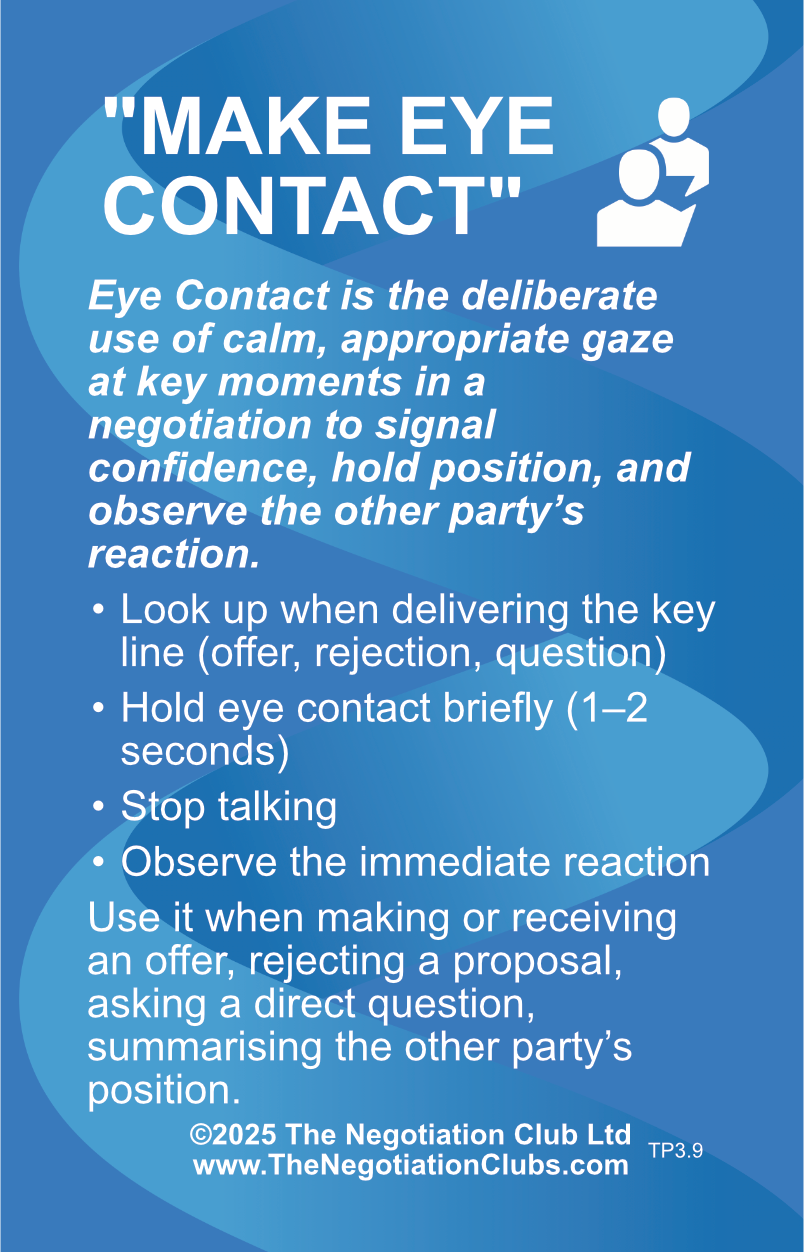
Introducing the "Make Eye Contact" Negotiation Card
The Eye Contact Negotiation Card is designed to turn presence from an instinct into an observable, practised negotiation skill.
Used in short, timed negotiations, the card helps participants practise:
-
Holding position without over-explaining
-
Using silence to let offers and rejections land
-
Observing reactions at key decision moments
-
Staying composed under pressure
Add this card to your deck and refine your ability to control pace, read responses, and let the other party do more of the work.
How to practise Eye Contact (short drills)
Eye contact improves through repetition, not awareness.
Drill 1 – Offer and Stop (3 minutes)
Make six short offers. Each time:
-
Look up
-
Deliver the offer
-
Hold briefly
-
Stop talking
Drill 2 – Calm Rejection (3 minutes)
Reject six unreasonable offers using one sentence only, steady gaze, neutral tone.
Drill 3 – Observation Focus (5 minutes)
Run a short role play. Observers only track:
-
Eye contact at offers
-
Eye contact at rejections
-
Eye contact during summaries
Debrief on what reactions were actually observed.
Video call adaptation
On Zoom or Teams, use the camera briefly when delivering key lines, then switch to screen view to observe reactions.
Observer feedback prompts
Observers should assess execution, not outcome.
-
Did the negotiator maintain eye contact at key moments?
-
Did they stop talking after the offer or rejection?
-
Did eye contact support silence and observation?
-
Did they adjust intensity appropriately?
-
What immediate reaction did eye contact reveal?
Feedback should reference specific moments, not general impressions.
In practice
Eye contact is a small behaviour with a disproportionate impact.
When paired with silence and observation, it becomes a powerful way to hold position, read the room, and let the other party do the work.
"As with all negotiation tactics, its effectiveness comes from practice, not intention."
Check Your Knowledge
If you can answer each question, you're already halfway to success!
The next step is simple: just PRACTICE.
1. Is eye contact really a negotiation tactic or just body language?
2. How long should I hold eye contact in a negotiation?
3. Should I maintain eye contact while the other party is speaking?
4. Can eye contact be used when rejecting an offer?
5. How does eye contact work in online or video negotiations?
6. How can I practise eye contact without making it awkward?
Practicing at The Negotiation Club
Understanding negotiation tactics and techniques is just the first step because their effective application always require... practice! This is where negotiation clubs or practice groups can be invaluable so JOIN our club today and get a 30 Day FREE Trial!


Club Members Giving Constructive Feedback
At The Negotiation Club, the Observer plays a critical role in how negotiation skills are developed through practice.
During each practice negotiation, the Observer focuses on the execution of a specific tactic, not the outcome of the negotiation. Their role is to watch what actually happens in real time—how the tactic is attempted, how it is delivered, and how the other party responds.
Feedback is structured, immediate, and constructive. It is based on observable behaviour rather than opinion and is reviewed against three clear levels of ability:
- Awareness – the tactic is recognised and attempted
- Application – the tactic is used deliberately and appropriately
- Control – the tactic is used fluidly and adapted to the situation
This observer-led approach ensures feedback is practical, focused, and directly supports skill development through repetition and reflection
Level 1
The participant recognises the tactic and attempts to apply it, though inconsistently.
Level 2
The participant integrates the tactic effectively into the negotiation, contributing to the discussion.
Level 3
The participant uses the tactic skilfully, influencing the negotiation outcome or advancing their position meaningfully.