
“Credibility is tested the moment you say ‘final’.”
How To Use A 'Final Offer' Negotiation Tactic.

My Final Offer (Negotiation Tactic)
“My final offer” is a high-commitment closure tactic. It can end a negotiation efficiently, but it can also destroy credibility if you use it too early, without leverage, or if you retreat from it.
At The Negotiation Club, we treat “My Final Offer” as an advanced execution skill — not a phrase you throw in when you feel stuck.
What This Tactic Is (In Practice)
When you say “This is my final offer”, you are doing three things at once:
-
Signalling closure: you are moving the negotiation from discussion into decision.
-
Applying pressure: you are forcing an accept/reject response.
-
Restricting your own flexibility: you are committing to no further movement.
Used correctly, it is decisive. Used poorly, it becomes an empty threat.
When “My Final Offer” Works
This tactic is most effective when all of the following are true:
-
The key variables have been discussed (not just price).
-
You have a clear walk-away point and you are prepared to use it.
-
The other party believes you (your behaviour matches your words).
-
You have already tested movement and the negotiation has narrowed.
If you have not established these conditions, you do not yet have a “final offer”. You have a wish!
When It Damages You
“My final offer” creates immediate problems when:
-
You use it too early ...before exploring variables and trades.
-
You use it without consequences ...you say “final” and then move again.
-
You use it emotionally ...it becomes a frustration statement rather than a decision.
-
You use it as a bluff ... and get called on it.
Once you retreat from a “final offer”, the other party learns a lesson:
... your boundaries can be negotiated by waiting you out!
How to Say It Without Losing Credibility
If you choose to use this tactic, your delivery must be controlled and clean:
-
Be short.
-
Avoid long explanations.
-
Avoid “maybe”, “sort of”, “a little bit”.
-
Do not over-justify.
Examples:
Direct
-
“That’s my final offer.”
Final with a clear boundary
-
“That’s my final offer. If that doesn’t work, we should stop here.”
Final with time to decide
-
“That’s my final offer. Take a moment... I’m happy to pause while you consider it.”
What to avoid:
-
“That’s my final offer… unless…”
-
“That’s my final offer, but what were you thinking?”
-
Any version where you keep negotiating immediately afterwards!
The Key Principle: Final Means Final
A real final offer has an implied consequence:
-
If accepted.... you close.
-
If rejected.... you end or step back materially.
If you are not willing to do that, practise a different closure tactic first (see below).
A Safer Alternative to Practise First: Conditional Closure
Before progressing to “My Final Offer”, practise conditional language:
-
“If we can agree X, then I can confirm Y.”
-
“If you can commit to A, I can move on B.”
-
“If we settle this today, I can hold this price.”
This keeps your options open and encourages trading rather than deadlock.
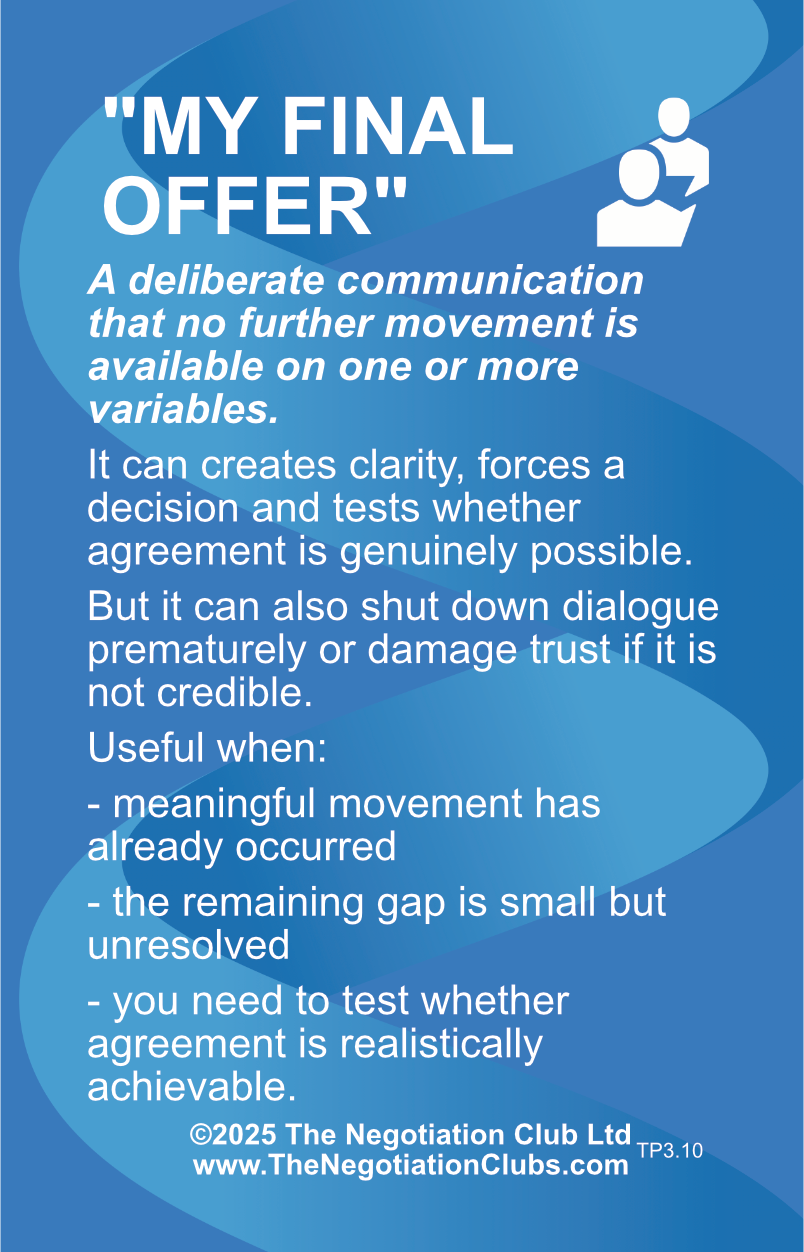
Introducing the 'Final Offer' Negotiation Card
The Final Offer Negotiation Card is designed to turn the declaration of limits from a risky statement into a controlled, practised negotiation skill.
Used in short, timed negotiations, the card helps participants practise:
-
Timing the introduction of a final position without closing dialogue too early
-
Communicating limits clearly and credibly
-
Holding position without over-explaining or backtracking
Add this card to your deck to refine your ability to test whether agreement is genuinely possible — without relying on pressure, bluffing, or false ultimatums.
How to Practise “My Final Offer” (Club Drill)
This tactic cannot be learned by reading. It must be practised because it is primarily about timing, tone, and commitment.
Practice Drill: The Final Offer Commitment Test (10 minutes)
Setup
-
Use a two-variable negotiation card (e.g., price + payment terms).
-
Run a 5-minute negotiation as normal.
Rule
-
At any point, either party may state “My final offer”.
-
The moment it is stated, the other party must choose:
-
Accept
-
Reject (and the negotiation ends immediately)
-
Observer focus
-
Was the final offer used too early?
-
Did the negotiator earn the right to use it (information, trading, narrowing)?
-
Did the negotiator stay consistent after stating “final”?
-
Did the delivery sound controlled or emotional?
Repeat
-
Swap roles and run again.
-
The goal is not “winning”. The goal is clean execution.
Practice Drill: The Credibility Penalty Round (8 minutes)
In this version, credibility is scored....
The FINAL Rule:
If a negotiator says “final offer” and then moves again, they automatically lose the round (regardless of outcome).
...This builds discipline and helps negotiators stop using “final” as a pressure reflex.
Check Your Knowledge
If you can answer each question, you're already halfway to success!
The next step is simple: just PRACTICE.
1. Is a “Last Offer” the same as an ultimatum?
2. When is the right time to use a Last Offer?
3. What happens if the other party rejects my Last Offer?
4. Can I still negotiate after making a Last Offer?
5. Should I explain or justify a Last Offer in detail?
6. Is a Last Offer suitable for all negotiations?
Practicing at The Negotiation Club
Understanding negotiation tactics and techniques is just the first step because their effective application always require... practice! This is where negotiation clubs or practice groups can be invaluable so JOIN our club today and get a 30 Day FREE Trial!


Club Members Giving Constructive Feedback
At The Negotiation Club, the Observer plays a critical role in how negotiation skills are developed through practice.
During each practice negotiation, the Observer focuses on the execution of a specific tactic, not the outcome of the negotiation. Their role is to watch what actually happens in real time—how the tactic is attempted, how it is delivered, and how the other party responds.
Feedback is structured, immediate, and constructive. It is based on observable behaviour rather than opinion and is reviewed against three clear levels of ability:
- Awareness – the tactic is recognised and attempted
- Application – the tactic is used deliberately and appropriately
- Control – the tactic is used fluidly and adapted to the situation
This observer-led approach ensures feedback is practical, focused, and directly supports skill development through repetition and reflection
Level 1
The participant recognises the tactic and attempts to apply it, though inconsistently.
Level 2
The participant integrates the tactic effectively into the negotiation, contributing to the discussion.
Level 3
The participant uses the tactic skilfully, influencing the negotiation outcome or advancing their position meaningfully.